



How Ukrainians feel in the 4th year of war and how they cope

The full research report is available for download via the form below.
Fatigue is rising, fear is declining: how Ukrainians’ mental health has changed since the start of the full-scale war — Gradus survey
Fatigue has become the dominant emotional state among Ukrainians today, while the level of fear is gradually decreasing. This is evidenced by the results of a Gradus survey conducted in December 2025. Some indicators were compared with responses to similar questions asked almost two years earlier, in January 2024.
According to the survey, 52% of respondents said that fatigue is the emotion they have been feeling most often recently — the highest figure among all emotional states measured. It is followed by tension (43%), irritation and frustration (35% and 34%, respectively). Hope ranks fifth, mentioned by 33% of respondents. At the same time, researchers note that compared to data from two years ago, the level of fatigue has increased, while the level of fear has somewhat decreased.
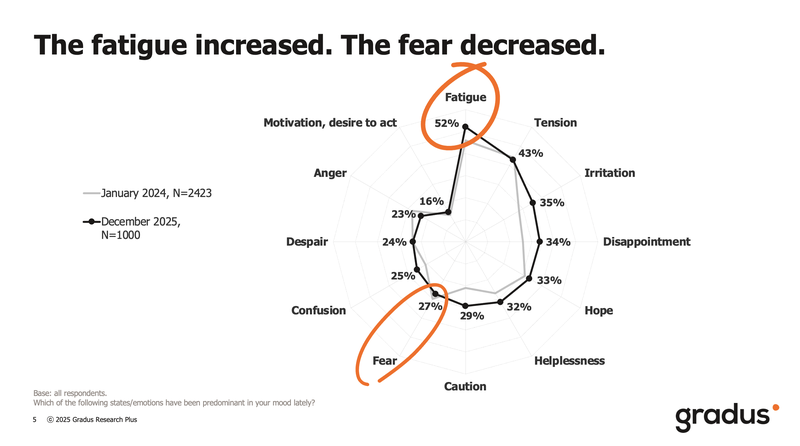
When assessing their quality of life, 72% of Ukrainians described it as low. The main factors behind this assessment are the security situation and concerns for the life and health of loved ones, cited by 63% of respondents. Financial difficulties were mentioned by 59%, and constant concern for personal safety by 56%. Less frequently, though still significantly, people are worried about mobilization (33%) and a perceived lack of support from the state (34%).
Self-assessments of psychological well-being are also deteriorating. The share of those who consider their mental state satisfactory declined from 36% in 2024 to 29% in 2025. At the same time, the proportion of respondents who rate their condition as average has remained almost unchanged.
Against the backdrop of growing fatigue, the need for psychological support remains consistently high. Over the past six months, 41% of Ukrainians have felt a need for psychological assistance. Actual help-seeking, however, remains limited: only 7% reported having consulted specialists, while another 24% say they are considering this option.
To cope with stress and anxiety, Ukrainians most often turn to digital entertainment — the internet, music, television, films and series — as well as communication with friends and family. Over the past two years, there has also been a noticeable increase in the share of those who choose favorite activities and hobbies, walks in nature, and sports to stabilize their emotional state.
A comparative analysis of the two periods shows a slight decrease in levels of anxiety, tension, and sleep problems. At the same time, the number of people experiencing complex symptoms indicative of prolonged stress has increased, including a lack of motivation and reduced productivity.
Symptoms that may indicate PTSD remain widespread. Signs such as emotional exhaustion, sleep disturbances, anxiety, and irritability are reported by 41% to 45% of respondents. Other PTSD-related symptoms are noted by 30% to 37%.
“We see that Ukrainian society is gradually adapting to the prolonged stress of war and, across many dimensions, demonstrates relative stability. At the same time, this adaptation comes at a high cost — accumulated fatigue and the gradual depletion of internal resources,” says Yevgeniya Blyznyuk, Founder and CEO of Gradus Research.
The survey was conducted by the research company Gradus using a self-administered questionnaire in the Gradus mobile application. Target audience: men and women aged 18–60 living in Ukrainian cities with a population of over 50,000, excluding temporarily occupied territories and areas of active hostilities. Fieldwork period: December 4, 2025. Sample size: 1,000 respondents.
The full survey report is available for download via the form below.
The Digital Ethnography 2025 research report is available on a commercial basis upon request at dn@gradus.app
Report structure:
● Morning rituals and the structure of the day
● Rituals across all areas of life
● Food behavior and habits
● Stress and coping mechanisms
● Consumption patterns and shopping
● Media use and digital habits
● Leisure and social connections
● Urban specifics and wartime context
● Social activity of young people
Want a broader perspective?
The “Digital Ethnography of Ukrainians 2025” report offers deep insights into today’s trends, but the world changes every day. Stay up-to-date on social sentiment and consumer behavior with Gradus Subscription.
The subscription offers better value than individual reports:
● Annual access to systematic trend monitoring
● Fresh insights as soon as data updates
● Ability to choose from ready packages or build a custom set of reports at a discount
👉 Pay less — get more insights.
To purchase the “Digital Ethnography of Ukrainians 2025” report or the Gradus Subscription, email dn@gradus.app
Other reports
-
 Fewer Donations, Unwavering Trust in the AFU, and Fears and Hopes Among UkrainiansFebruary 2026Special survey on the fourth anniversary of the full-scale invasion
 -
 How Perceptions of Relationships, Sex, and Valentine’s Day Are ChangingFebruary 2026Special survey for Valentine's Day
 -
 Stress in Europe and Ukraine: Young People’s Perceptions of LifeFebruary 2026International survey on the emotional state of young people, sources of stress, and attitudes toward work and life
 -
 Most Ukrainians are staying home despite blackoutsJanuary 2026Special survey on the impact of blackouts on Ukrainians' migration attitudes