



Most Ukrainians are staying home despite blackouts

Regular hostile attacks on Ukraine’s energy system, combined with the coldest winter in the past four years, are significantly complicating the daily lives of Ukrainians. Despite this, disruptions to electricity, water supply, and heating are not yet a reason for most people to change their place of residence. A survey conducted by Gradus in January 2026 shows that the majority of respondents do not plan to relocate unless the situation becomes critical. Only as a last resort does a small share consider a temporary move, with the intention of returning once the situation stabilizes.
People are adapting to crisis conditions and do not plan to leave en masse
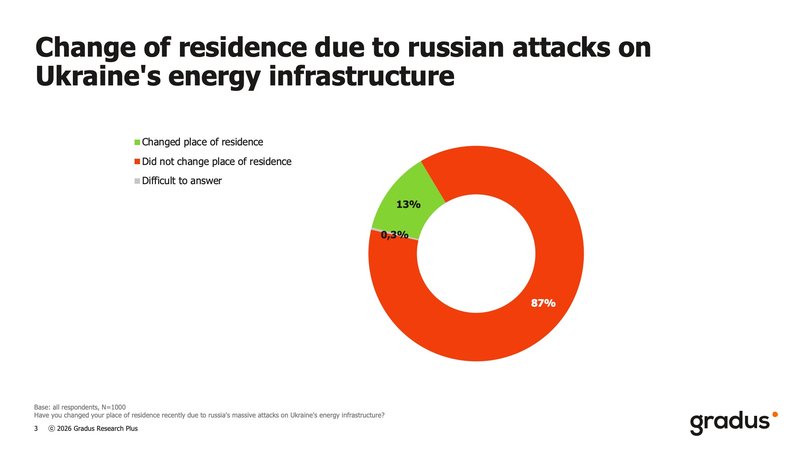
The survey found that 87% of respondents have not changed their place of residence due to attacks on the energy sector and the related everyday difficulties. The most mobile groups were residents of the East and Kyiv—regions most affected by attacks on energy infrastructure. Temporary relocation from these areas was reported by 21% and 18% of respondents, respectively.
Among the 13% who were forced to migrate due to energy-related hardship, 60% moved within their own region, while another 50% relocated to a different region within Ukraine. Most respondents intend to return to their permanent place of residence after temperatures rise and as soon as the security situation allows. However, a significant share of residents of the Eastern and Northern regions (16% and 22%, respectively) do not currently plan to return.
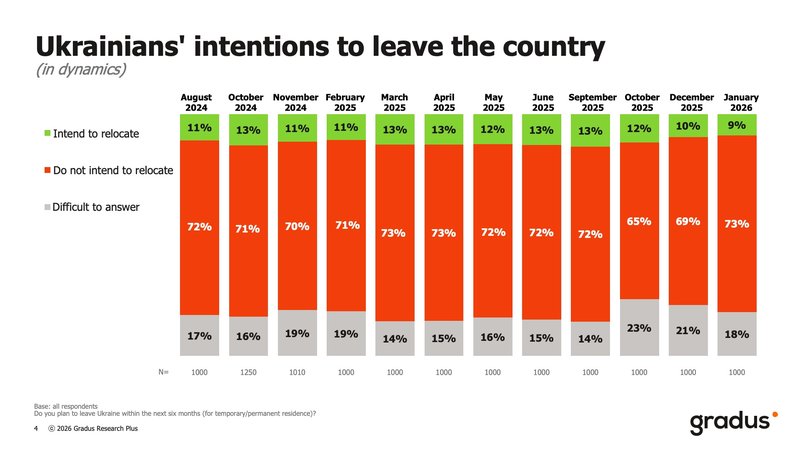
Less than 10% of respondents intend to leave Ukraine within the next six months, which corresponds to the level of migration intentions recorded in previous Gradus surveys. Thus, intense attacks on energy infrastructure have not led to an increase in migration intentions.
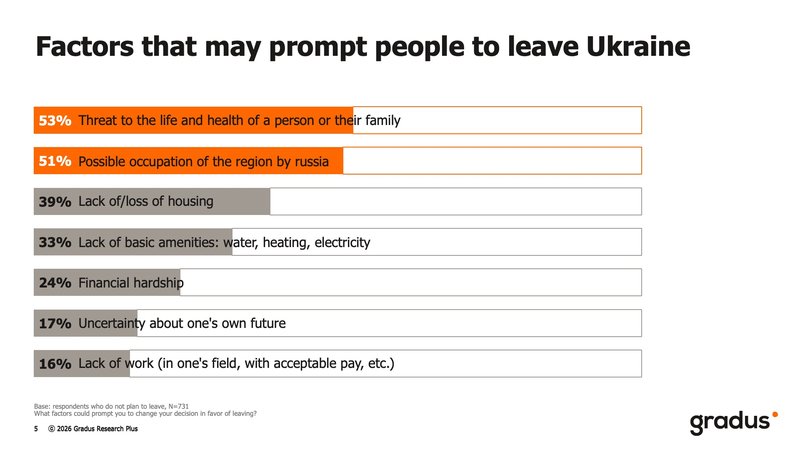
Among the factors that could prompt a change of decision in favor of leaving, the most significant are threats to one’s own life or the lives of family members, the possible occupation of the region by Russia, loss of housing, or the absence of basic living conditions such as water, heating, and electricity. At the same time, the lack of household utilities is still not the primary reason among potential drivers of relocation.
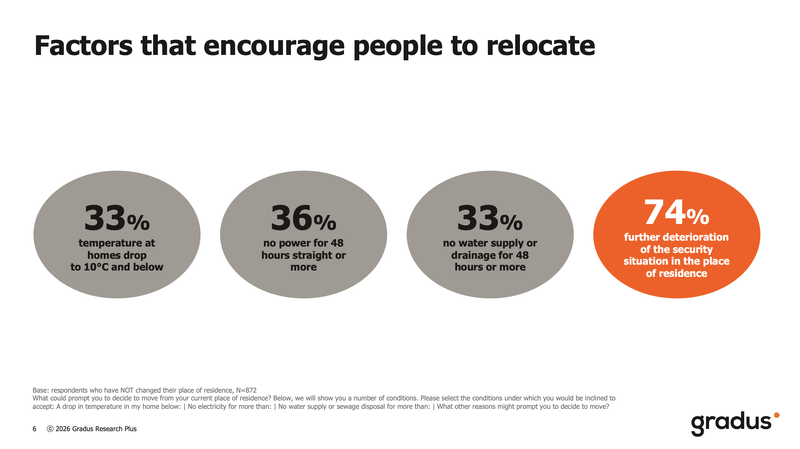
In the event of further deterioration of the situation and living conditions, fewer than half of respondents (43%) are ready to change their current place of residence. Factors that could trigger such a decision include indoor temperatures dropping below 10°C, or the absence of electricity, water supply, or sewage services for more than 48 consecutive hours. However, as before, the only truly decisive reason to leave the current place of residence remains a further deterioration of the security situation.
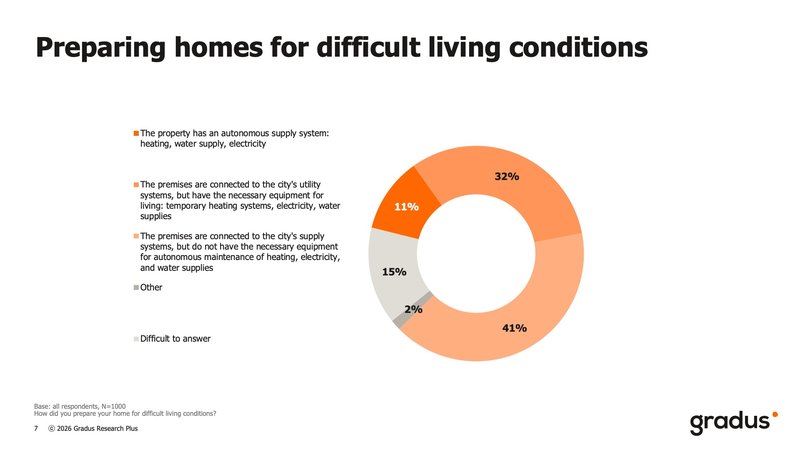
A significant share of respondents prepared their homes in advance for a difficult winter by installing necessary equipment or even securing autonomous supply. At the same time, an equally large share lacks such equipment and is fully dependent on municipal services.
“Ukrainians who chose to stay in their homes during the war are not inclined to change this decision under such harsh circumstances as the lack of basic utilities and cold. Even a possible radical deterioration in quality of life could prompt departure for only about a third of respondents, and only for a short period of time. This indicates that the energy terror tactics used by Russia significantly complicate Ukrainians’ lives, but do not constitute a factor capable of triggering a repeat of the migration wave we observed in the first months of the full-scale invasion. After this winter, the population will approach the preparation of their homes and daily life for the next cold season even more thoroughly,” comments Evgeniya Blyznyuk, sociologist, Founder and CEO of Gradus.
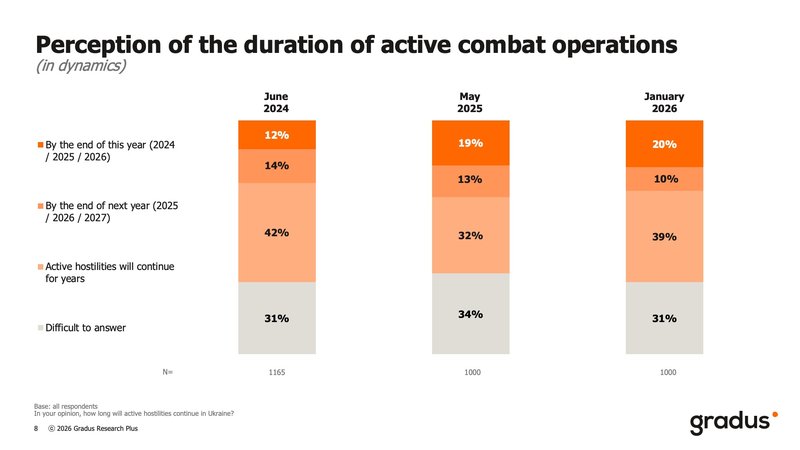
Overall, expectations of a prolonged war remain unchanged. This indicator reacts far less to any peace initiatives or negotiations than it did at the beginning of 2025.
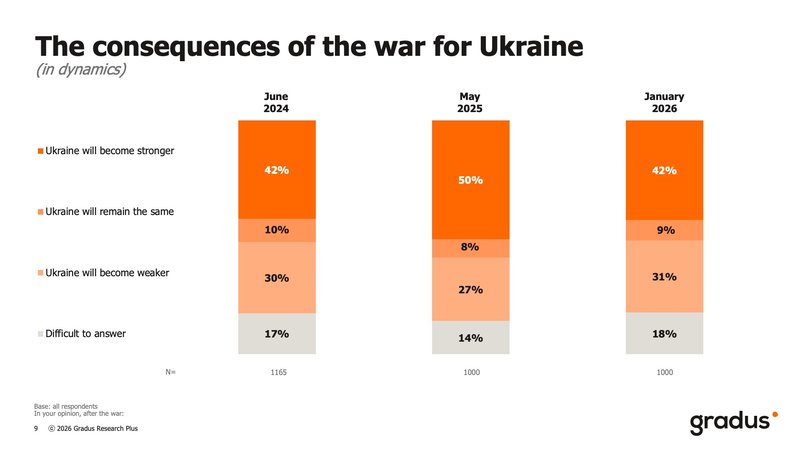
However, despite the harsh winter and the prospect of a long war, a significant share of respondents remains optimistic and expects that Ukraine will emerge stronger as a result of this war.
The survey was conducted by the research company Gradus using a self-administered questionnaire in the Gradus mobile application. Target audience: men and women aged 18–60 living in Ukrainian cities with a population of over 50,000, excluding temporarily occupied territories and areas of active hostilities. Fieldwork period: January 22, 2026. Sample size: 1,000 respondents.
Other reports
-
 Friendly and unfriendly countries, attitudes toward the EU, NATO, and the UNMarch 2026How the map of friendly and unfriendly countries has changed over the past year, and attitudes toward the EU, NATO, and the UN
 -
 Perception of advertising during wartimeMarch 2026Advertising during wartime: where Ukrainians see it, what annoys them, and what makes them pay attention
 -
 Fewer Donations, Unwavering Trust in the AFU, and Fears and Hopes Among UkrainiansFebruary 2026Special survey on the fourth anniversary of the full-scale invasion
 -
 How Perceptions of Relationships, Sex, and Valentine’s Day Are ChangingFebruary 2026Special survey for Valentine's Day