To what extent does the stress level among young Ukrainians differ from their peers in Europe and why? The research company Gradus conducted a study among working urban residents aged 25–35 in Ukraine and the five largest European economies — the UK, Germany, France, Italy, and the Netherlands — to compare the emotional state of youth, sources of stress, and attitudes toward work and life. The survey results showed that the war and the related daily challenges definitely influence stress levels, but in some areas, Ukrainian and European youth are comparable in terms of the causes and intensity of their worries.
Stress and burnout: Ukraine against the backdrop of Europe
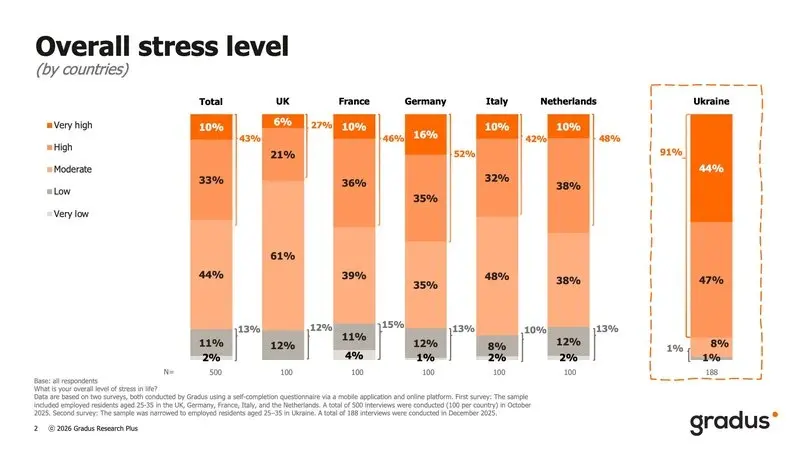
A comparison of Ukraine with European countries demonstrates both common trends and significant differences. However, in terms of the general stress level, Ukraine stands out sharply among all the countries surveyed. While in the UK only 27% of respondents report a high or very high level of stress, in Germany it is 52%, and in other European countries — 42–48%, in Ukraine this indicator reaches 91%. Of these, 44% of respondents rate their stress as very high. Such a gap reflects the prolonged impact of the full-scale war and its associated negative consequences in the life of every Ukrainian.
General stress level
But in the sphere of work, the situation is more uniform. 45% of surveyed Ukrainians call work issues a significant source of stress — this is comparable to EU figures (32% in the UK and 34% in the Netherlands, compared to 45–46% in Germany, France, and Italy). At the same time, financial difficulties trouble 43% of surveyed Ukrainians aged 25-35, which emphasizes a combination of economic and security challenges less characteristic of European countries.
Thoughts about quitting due to burnout are common in all countries: 42% of respondents indicated that they had thought about changing jobs for this reason at least once. In Europe, women report this more often than men (46% versus 36%). At the same time, noticeable differences are visible between European countries: in the UK, only 25% of respondents considered the possibility of quitting, while in France and Italy — about half, and in Germany and the Netherlands — 43%.
Fatigue and lack of time are universal, but not the main ones for Ukrainians
In all surveyed European countries, the main sources of stress remain fatigue and a lack of personal time (33%), as well as work issues (31%). However, for Ukrainians, these factors exist against the background of significantly deeper stress, caused by danger and the need for constant adaptation to difficult living conditions. This is evidenced by the fact that 51% of Ukrainian respondents named the socio-political situation in the country and 33% — the situation in the world — as the main stress factor.
Current sources of stress
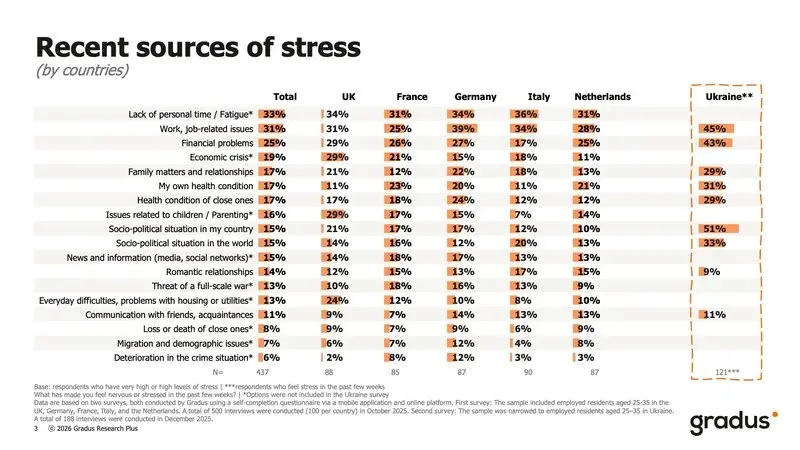
Ukraine also differs significantly in the level of general anxiety provoked by economic factors. In the UK, 28% of respondents report stress related to the economic crisis, compared to only 11% in the Netherlands.
The British also most often report stress related to raising children (28%), while in Italy this indicator is 7%. Stress due to health and physical well-being, most common in Ukraine — 31%, among European countries is of most concern to the French (22%), followed by Germany and the Netherlands (20% each), and this issue worries the British and Italians significantly less (11% each).
Comparing with European countries demonstrates that in Ukraine, we are dealing not just with a higher level of stress, but with chronic and systemic psychological pressure. In EU countries, stress is usually a reaction to individual factors — work, financial instability, or life changes. In Ukraine, stress is formed in conditions of a prolonged absence of basic predictability, when no sphere of life — from career to family plans — is perceived as stable. This creates a cumulative effect: even with formally preserved economic and social roles, people are in a mode of constant cognitive and emotional mobilization. This explains the combination of high stress indicators with work and financial triggers that are relatively typical for Europe,
— notes Evheniya Blyznyuk, sociologist, founder and CEO of Gradus.
The study was conducted by the research company Gradus using the self-administered questionnaire method in the Gradus mobile application. Target audience 1: working residents aged 25–35 in the UK, Germany, France, Italy, and the Netherlands. In total, 500 interviews were conducted in October 2025 (100 in each country). Fieldwork period — October 2025. Sample size: 500 respondents (100 in each country). Target audience 2: working residents aged 25–35 living in cities of Ukraine with a population of over 50,000, excluding temporarily occupied territories and zones of active hostilities. Fieldwork period — December 2025. Sample size: 188 respondents.