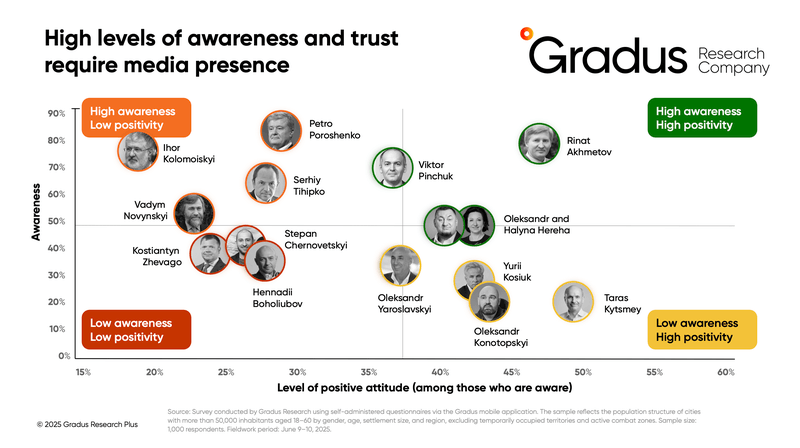
How has the attitude of Ukrainians toward business changed in wartime? What factors influence trust in entrepreneurs, and why do some receive more public support than others? Gradus Research conducted a special survey for Forbes Ukraine on the attitudes of the top 15 business leaders from the Forbes Ukraine list, as presented at the Entrepreneurs’ Forum 2025.
Overall, society’s attitude toward entrepreneurs is improving.
During the full-scale war, businesses have proven to be allies — pillars of support for both the military and the public; however, size matters. According to Gradus Research, those closest to the people — representatives of small and medium-sized businesses — enjoy higher levels of trust. Small businesses are often our neighbors, relatives, or friends, while medium-sized businesses are those that have grown from small-scale operations.
Large businesses, on the other hand, are perceived more ambiguously. They are under closer scrutiny and often associated with the oligarchic past or tight political connections, which leads to a significantly lower trust balance.
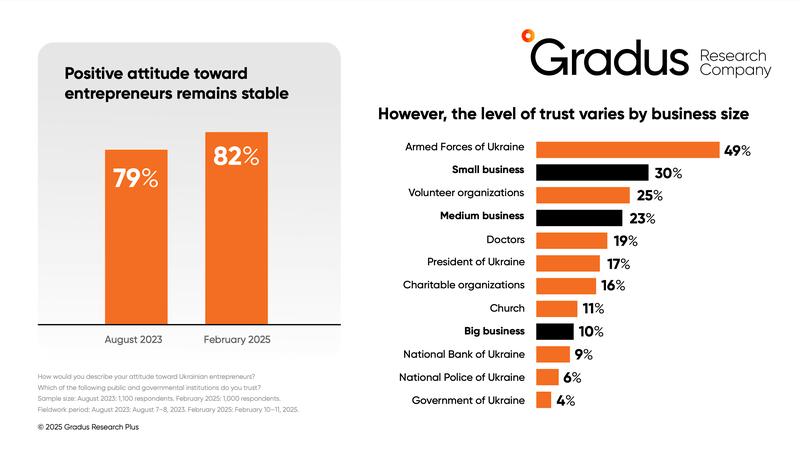
Still, despite the heightened scrutiny, the trust balance for big business is not bad — especially compared to the political community, where the trust balance is far lower.
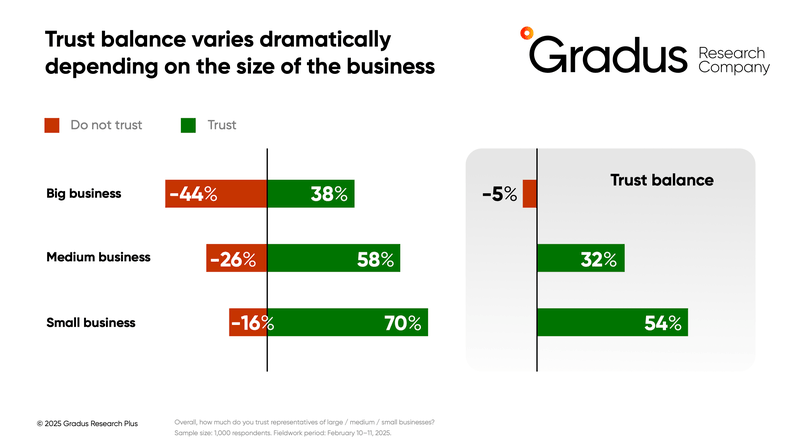
**Trust Balance is the difference between the share of those who trust and those who distrust a particular entrepreneur or company. A negative value indicates prevailing distrust.
Looking at specific cases, the most neutral or cautiously positive attitudes are toward those associated with development, technology, and new ideas. For example, Taras Kytsmei (balance: 0%), Oleksandr Konotopskyi (balance: -3%), and Yuriy Kosiuk (balance: -3%) face significantly less negativity. Meanwhile, well-known figures with high-profile political histories face greater criticism, which is natural given the public’s heightened sensitivity. Consequently, we see significantly higher negative ratings for Ihor Kolomoiskyi (balance: -47%) and Petro and Oleksiy Poroshenko (balances: -35% and -36%), as well as Vadym Novynskyi (-27%) and Serhiy Tihipko (-27%).
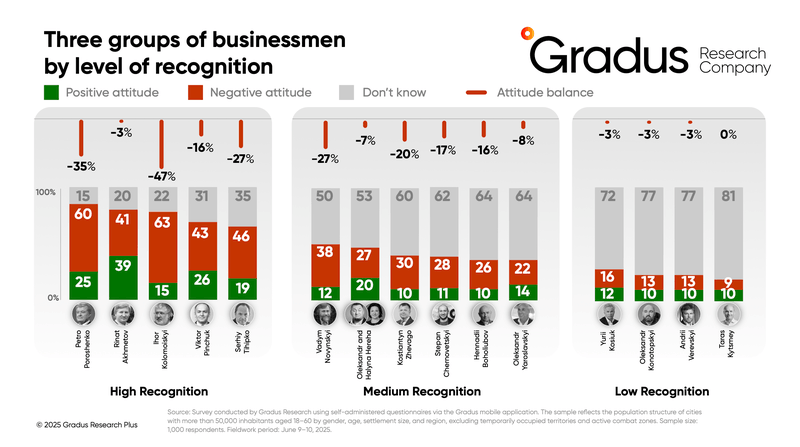
At the same time, data show that even among major entrepreneurs, some maintain a relatively stable reputation. For instance, Rinat Akhmetov — despite his political background and substantial share of negativity — holds a trust balance of -3%, which is far better than others of comparable scale. This can be explained by his wartime activities: systematic charitable aid, military support, and humanitarian projects that are visible and perceived as genuine contributions rather than mere PR.
“Despite the challenges, business today has a real opportunity to strengthen trust. Citizens notice tangible actions — community aid, reconstruction efforts, and support for those affected. And this goes beyond declarations; it’s about measurable contributions to national recovery: support for veterans and displaced persons, infrastructure rebuilding, transparent tax payments, and investments in local development. At the same time, society values transparent and honest communication from businesses — openness about challenges is perceived as positively as successful social or charitable initiatives,” says Evgeniya Blyzniuk, sociologist, founder and CEO of Gradus Research.
The survey was conducted by Gradus Research using a self-administered questionnaire in the Gradus mobile app. The sample reflects the population structure of cities with more than 50,000 residents aged 18–60 by gender, age, settlement size, and region, excluding temporarily occupied territories and areas of active hostilities. Sample size: 1,000 respondents. Fieldwork period: June 9–10, 2025.