Three quarters (75%) of Ukrainian entrepreneurs continue to do business. Almost all lost their business are planning to launch it again: most — after the war, a third — when it will be possible, without waiting for the war end, and a small part — as soon as possible, without waiting for a good opportunity. Gradus Research polled 303 owners and c-level managers of micro-, small, and medium businesses in Ukraine. The research was made in partnership with the Kyiv School of Economics (KSE).
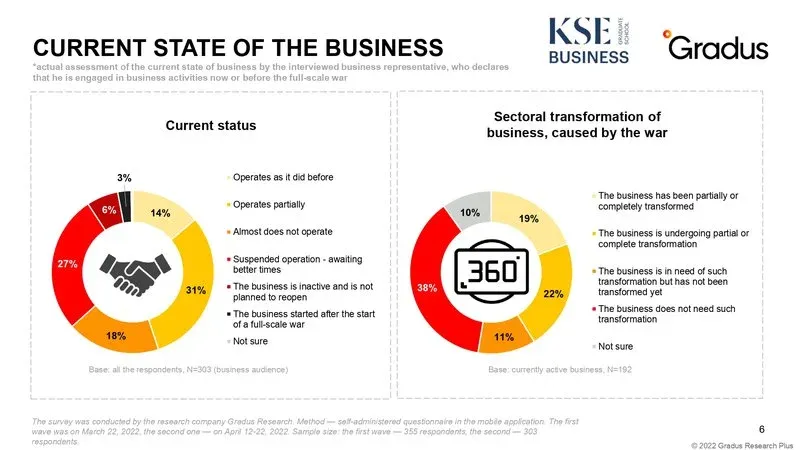
The number of respondents describing their business as ‘working’ and ‘partly working’ has increased (growth from 41% to 45%). And 38% of entrepreneurs said that their company will not need industrial transformation.
Ukrainian companies also renewed their intention to pay workers and suppliers. While in March 14% of employers planned to pay employees on the pre-war level, by the end of April this figure growed up to 23%. The number of those who do not plan to pay has decreased by a third (from 33% to 20%). Also there is a positive trend in payments to suppliers: the recovery of pre-war payments increased from 19% to 32%, and non-payments almost halved, from 29% to 16%.
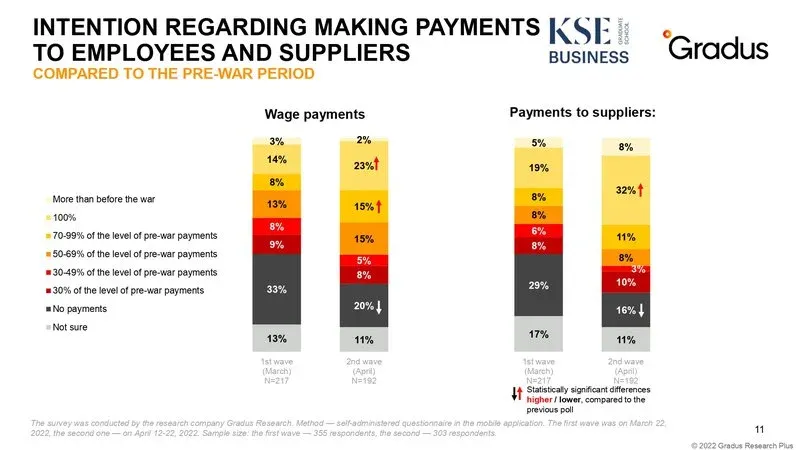
«Micro and small businesses have the highest “antifragility” compared to other forms of economic activity. For two years, the pandemic “trained” business to work under force majeure. First, such companies are more likely to switch and start selling demanded products. Secondly, some employees agreed informally with their staff on temporary salary cuts or even stop working (76%). Third, high speed of refocusing helps companies to be profitable even in wartime. The role of micro and small business for the Ukrainian economy can be compared to the legendary rescue of English and French corps by hundreds of small ships in Dunkirk in 1940,» Serhiy Gvozdev, a lecturer at KSE Graduate Business School, said.
Two thirds (61%) of the respondents that keep working stated they don’t need physical relocation. Only 10% reported that their business needs to be relocated, but it has not yet happened, and twice as many are either have moved or in the process. Half of the displaced companies (47%) made relocation to save their business. The second most common reason for forced relocation is try to tackle logistics issues.
More data from this study (in Ukrainian) is available upon request in the form on this page.
The survey was conducted by the research company Gradus Research. Method — self-administered questionnaire in the mobile application. The first wave was on March 22, 2022, the second one — on April 12-22, 2022. Sample size: the first wave — 355 respondents, the second — 303 respondents.