In the fifth year of the full-scale war, the consumer behavior of Ukrainians is noticeably polarizing: a part of the audience is moving to a more rational and cautious approach to spending, while the other consciously “holds the bar” of their usual level of consumption. At the same time, the demand for brands is also changing: expectations and perception of advertising increasingly correlate with the real context of life, daily challenges, and the emotional state of consumers. This is evidenced by a new wave of the annual research on consumer habits of Ukrainians, presented at the 19th Ukrainian Marketing Forum.
From savers to hedonists: how consumers are distributed
According to the results of the Gradus research, Ukrainians today are divided into four key segments, each of which has its own logic of decision-making and approaches to consumption.
Thus, 21% of the audience adheres to a saving model of behavior: these consumers save money, carefully plan expenses, and build stocks “for the future”. At the same time, 27% choose the strategy of rational optimization — they also control expenses but do so without significant changes to their usual way of life.
Along with this, 23% of surveyed Ukrainians belong to impulsive hedonists, who are guided by emotions and satisfaction “here and now”, not postponing life for later. And 29% are respondents with a strategy of free consumption: they are not prone to saving and strive to maintain their usual level of spending, despite external circumstances.
Segments
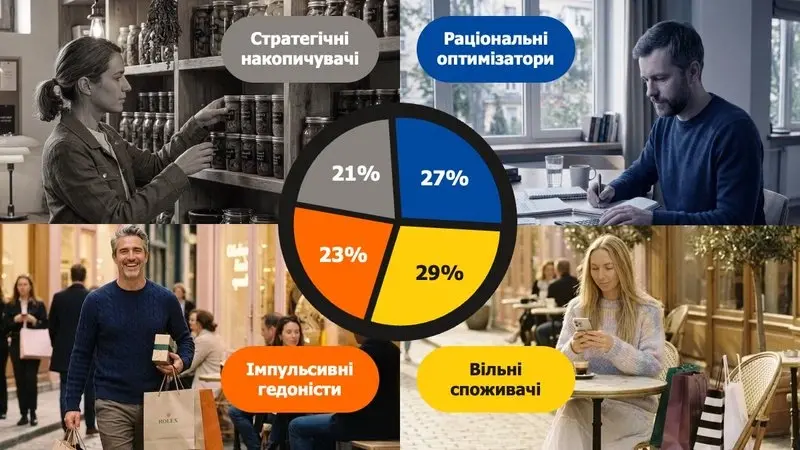
At the same time, it is worth noting that none of the segments is dominant. Consumer patterns are distributed approximately evenly, without creating a strong bias towards any of the strategies.
Pragmatism wins, but care is also important
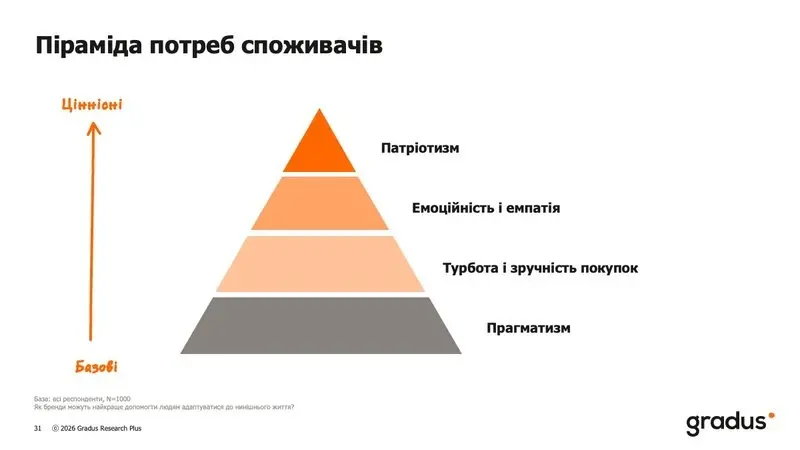
The behavior of Ukrainians can also be described through a conditional pyramid of needs, which reflects the logic of choosing goods and brands.
Pragmatism wins: price, discounts, and special offers remain key triggers of choice. The second level is formed by convenience and care: a simple customer journey, ready-made solutions, and time savings. A third of consumers pay attention to emotionality and empathy: they expect honest, open communication and positive emotions from interacting with a brand. A quarter of the respondents expect support for people, the country, and social initiatives.
Pyramid of consumer needs
Consumers want to see positivity in advertising that is not detached from reality
Against the backdrop of the war, Ukrainians have become significantly more sensitive to the tone and content of communications. They react sharply to insincerity and irrelevance, expecting brands to understand the context in which society lives.
In particular, only 9% of consumers positively perceive advertising with an “idealized” picture of life. Instead, messages that combine positivity with reality — without ignoring difficult topics and daily challenges — are becoming relevant.
Expectations from advertising
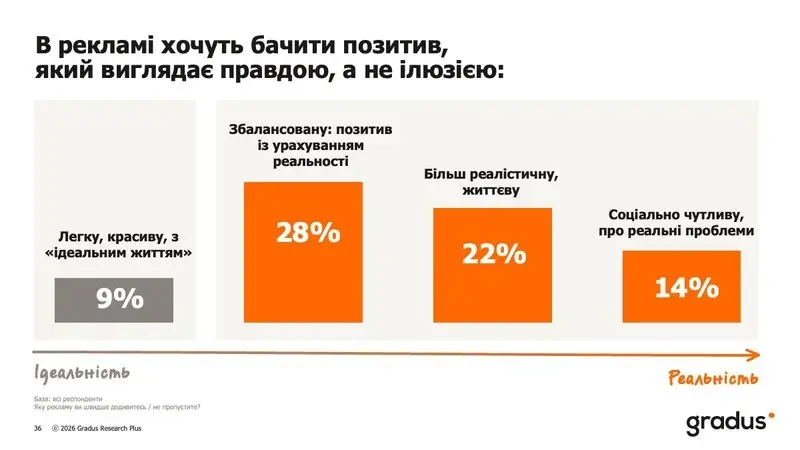
Thus, the demand for brands today can be formulated as a need for “good news from the real world” — communication that supports but does not detach from reality.
The Ukrainian consumer already lives in a new reality: on the one hand, more pragmatic and price-sensitive, on the other — with a clear need for small pleasures that help keep themselves resourceful and not postpone life for later. In this logic, the role of a brand also changes: its importance does not disappear, but the consumer looks for it in a new, comfortable price category. For brands, this means a new challenge — to remain relevant not through an image, but through an exact hit into the context of a person’s life,
— summarizes Evgeniya Bliznyuk, sociologist, founder and CEO of the research company Gradus.
The study was conducted by the research company Gradus using the method of self-completion of a questionnaire in the Gradus mobile application. The sample reflects the population structure of cities with more than 50,000 residents aged 18–60 by gender, age, settlement size, and region, excluding temporarily occupied territories and areas of active combat zones. Fieldwork period: March 23-24, 2026. Sample size: 1,000 respondents.
The full research report is available on a commercial basis at the link: https://umf.gradus.app/uk/