Almost a third of the respondents mostly ignore advertising, digital media have become the main channels of consumer contact with advertising, and consumers expect useful information, clarity, and friendly communication from messages. Gradus has researched how Ukrainians’ perception of advertising has changed in the conditions of a prolonged war, power outages, and information overload.
Where advertising “catches up” with Ukrainians during the war
The full-scale war has significantly changed the media consumption of Ukrainians, and along with it, the points of contact with advertising. According to the results of the Gradus research, users most often notice advertising messages in messengers and social networks — about half of the respondents (48%) encounter them there. For comparison, offline contact points — stores, transport, street advertising — fall significantly behind.
Advertising most often “catches up” in messengers and social networks
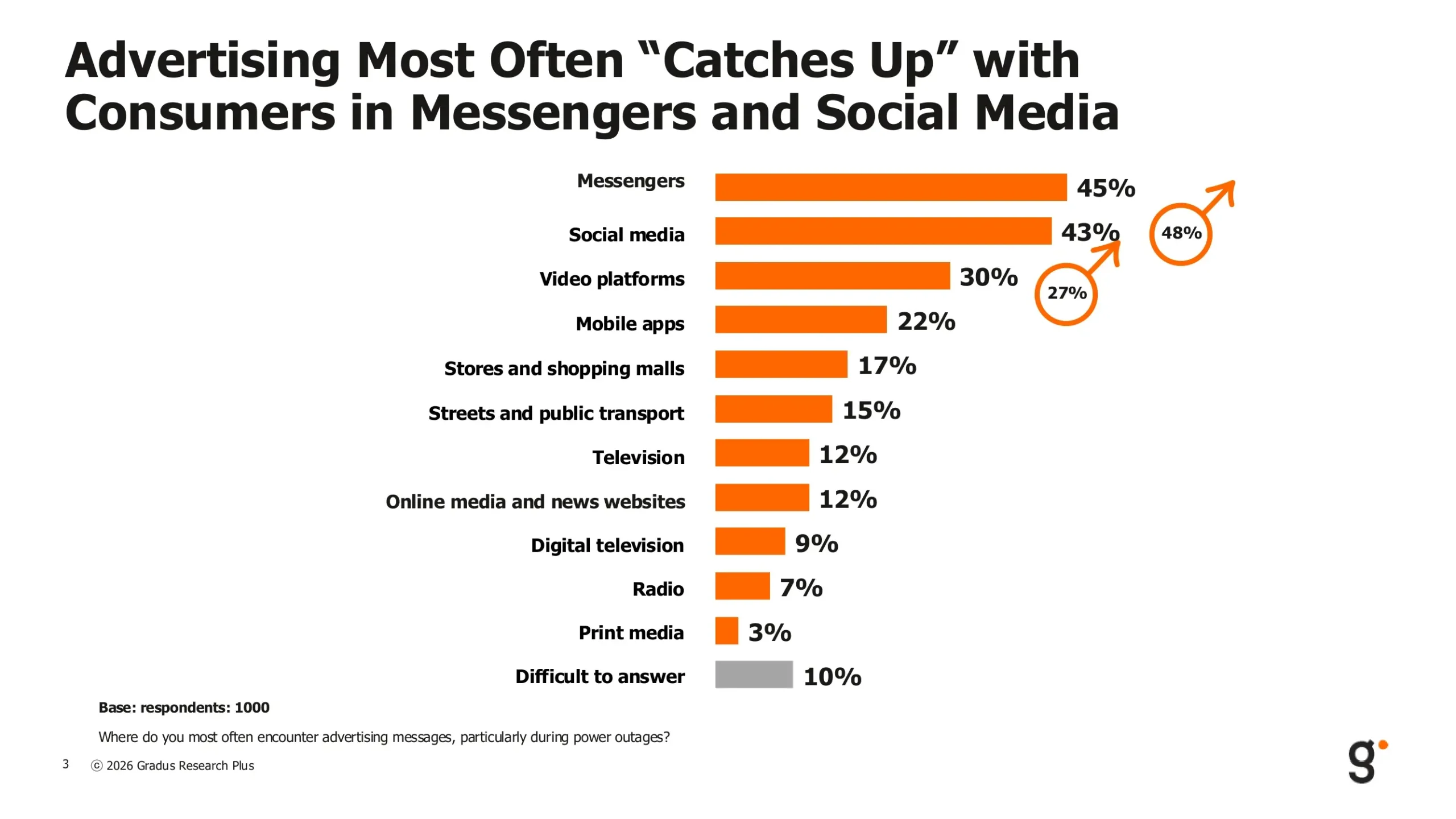
This environment has proven to be resilient even during periods of power outages. Mobile internet and short content formats allow brands to maintain contact with the audience when access to traditional media is limited.
Television also remains an important channel, but digital formats are gradually closing the gap. The research shows that digital TV is catching up with traditional television in terms of the frequency of contact with advertising. Digital TV is predominantly the choice of an audience under 44 years old, while traditional television maintains its position among people aged 55–60, which indicates an irreversible transition of the audience to the digital environment, with some inertia in older age groups.
What actually attracts attention in advertising
Despite the change in the information environment, the key trigger of attention remains quite pragmatic.
Most often, the attention of Ukrainians is attracted by discounts and promotional offers. This is especially characteristic of the younger audience: 47% of young respondents note that promo mechanics best attract their attention.
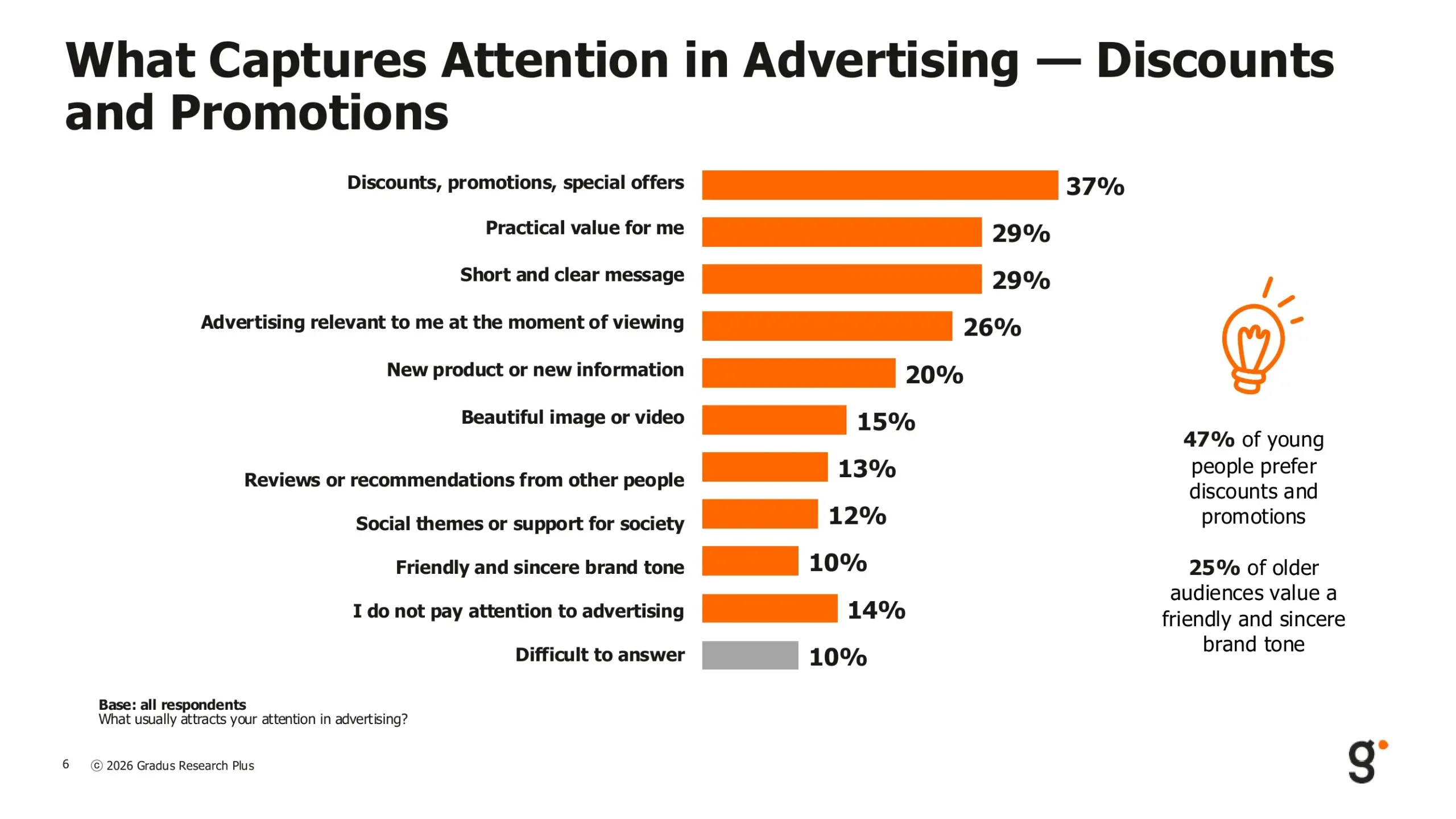
The older audience reacts somewhat differently to advertising signals. For them, a friendly and sincere style of brand communication plays an important role — this approach is chosen by about a quarter of older respondents.
These results demonstrate that in the conditions of a prolonged crisis, consumers simultaneously look for practical benefits and humanity in brand communication.
What advertising Ukrainians are ready to interact with
The research also shows a shift in interest towards short and interactive formats. The audience best perceives: short videos, messages in messengers, and interactive formats with the possibility of quick interaction.
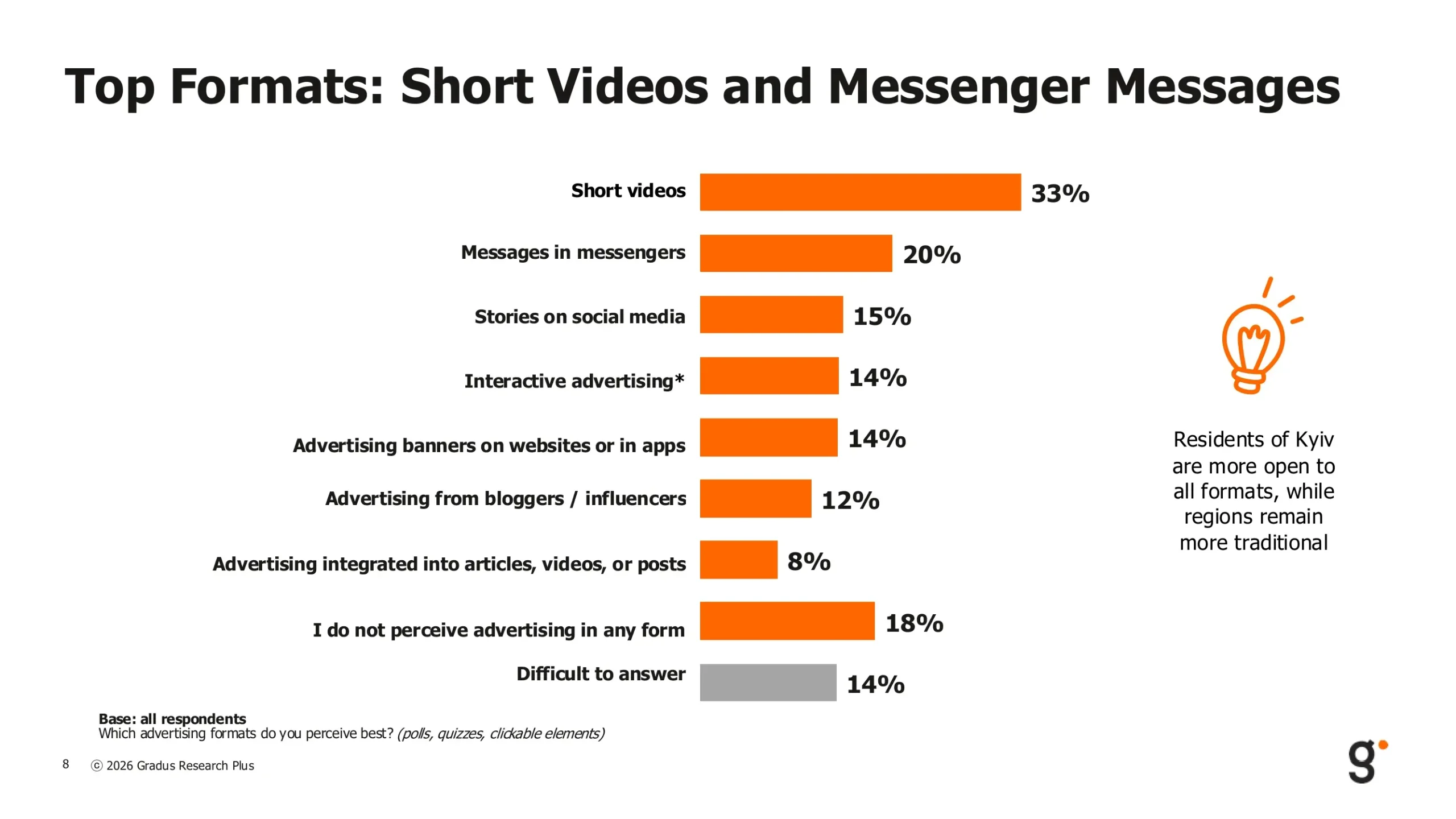
These formats correspond to the logic of modern media consumption: information is consumed quickly, often from a smartphone, during breaks between tasks or on the go.
At the same time, residents of Kyiv demonstrate greater openness to various advertising formats, while in the regions, the audience gravitates towards more familiar communication formats.
When advertising becomes annoying
Despite the general adaptation to advertising messages, a part of the audience reacts more sharply to them. In particular, 24% of young people note that advertising has recently seemed more aggressive or annoying to them. About a third of the respondents (29%) completely ignore advertising.
Useful advertising is the key to a positive attitude
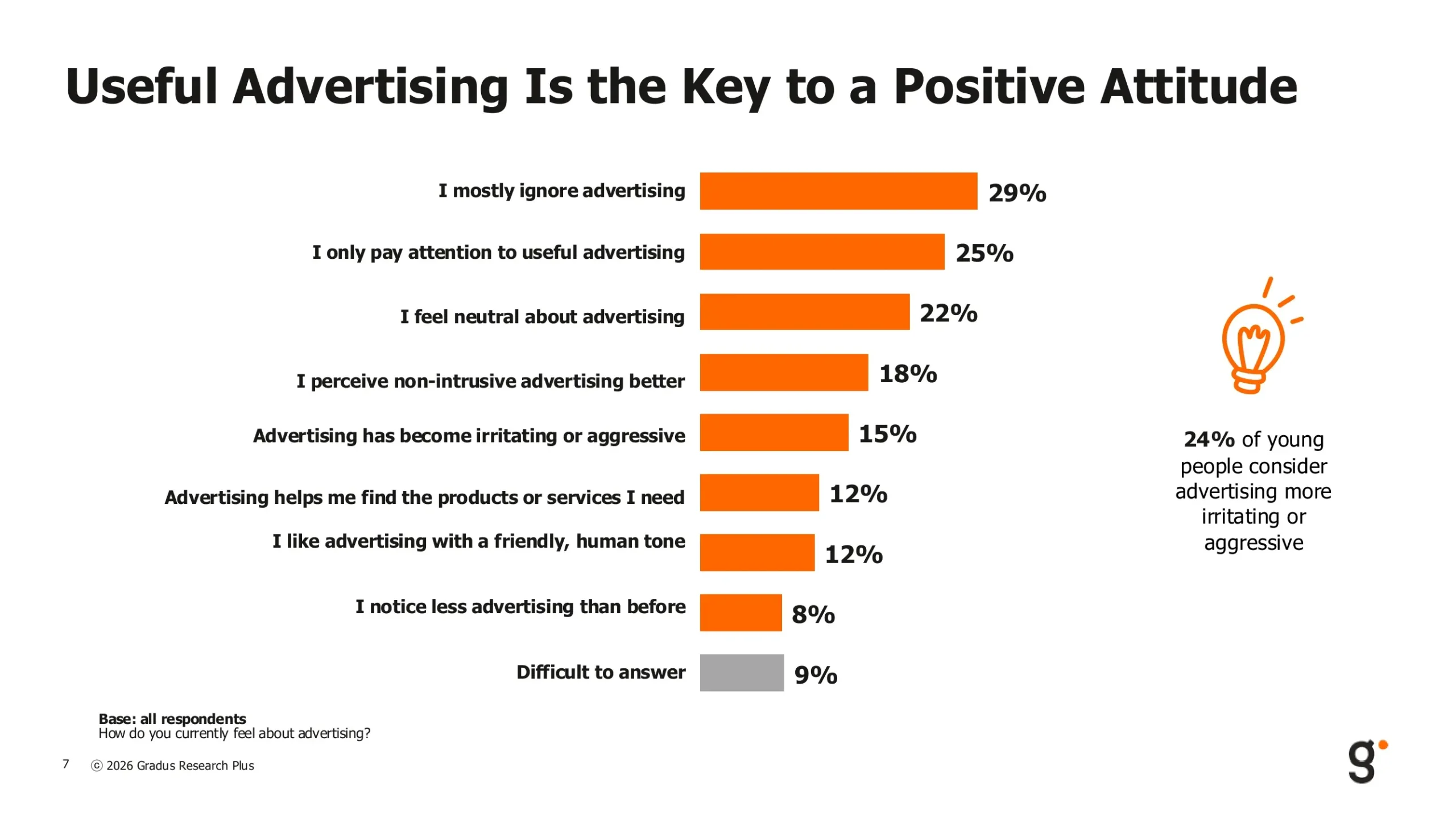
This is a signal for brands to work more carefully with the tonality of communication. In the conditions of war, people are in a state of increased emotional load, so intrusive or overly intensive advertising messages can cause a negative reaction.
The war has changed the context in which people perceive brand communication. Attention has become a more expensive resource, and tolerance for aggressive advertising has decreased. Ukrainians quickly filter out messages that have no practical value for them or sound unnatural. Instead, advertising that brings benefits — discounts, relevant offers, clear information — works well. And another important factor is tone. People respond much better to brands that speak to them simply, honestly, and without artificial idealization of reality,
— comments Evgeniya Bliznyuk, sociologist, CEO and founder of the research company Gradus.
The survey was conducted by the research company Gradus using the method of self-completion of a questionnaire in the Gradus mobile application. Target audience: men and women aged 18–60 living in Ukrainian cities with a population of over 50 thousand, excluding temporarily occupied territories and active combat zones. Survey period: February 13-16, 2026. Sample size: 1000 respondents.