In 2026, Ukrainians are becoming increasingly selective about which media they use for different needs: they most often turn to messaging apps for news, choose video platforms for entertainment, and consume content across several devices. At the same time, interest in news and socio-political programmes is lower than it was two years ago, while films and TV series continue to attract strong audience interest. These are among the findings of Gradus Research’s fifth wave study of media consumption among Ukrainians.
Digital channels remain where Ukrainians spend the largest share of their media time throughout the day. On average, people spend more than two hours a day consuming content on each of the following types of media: social media, messaging apps, and video platforms.
However, average time spent is only part of the picture. Some 42% of respondents spend more than three hours a day on messaging apps, 35% on video platforms, 28% on social media, and 15% on TV/OTT.
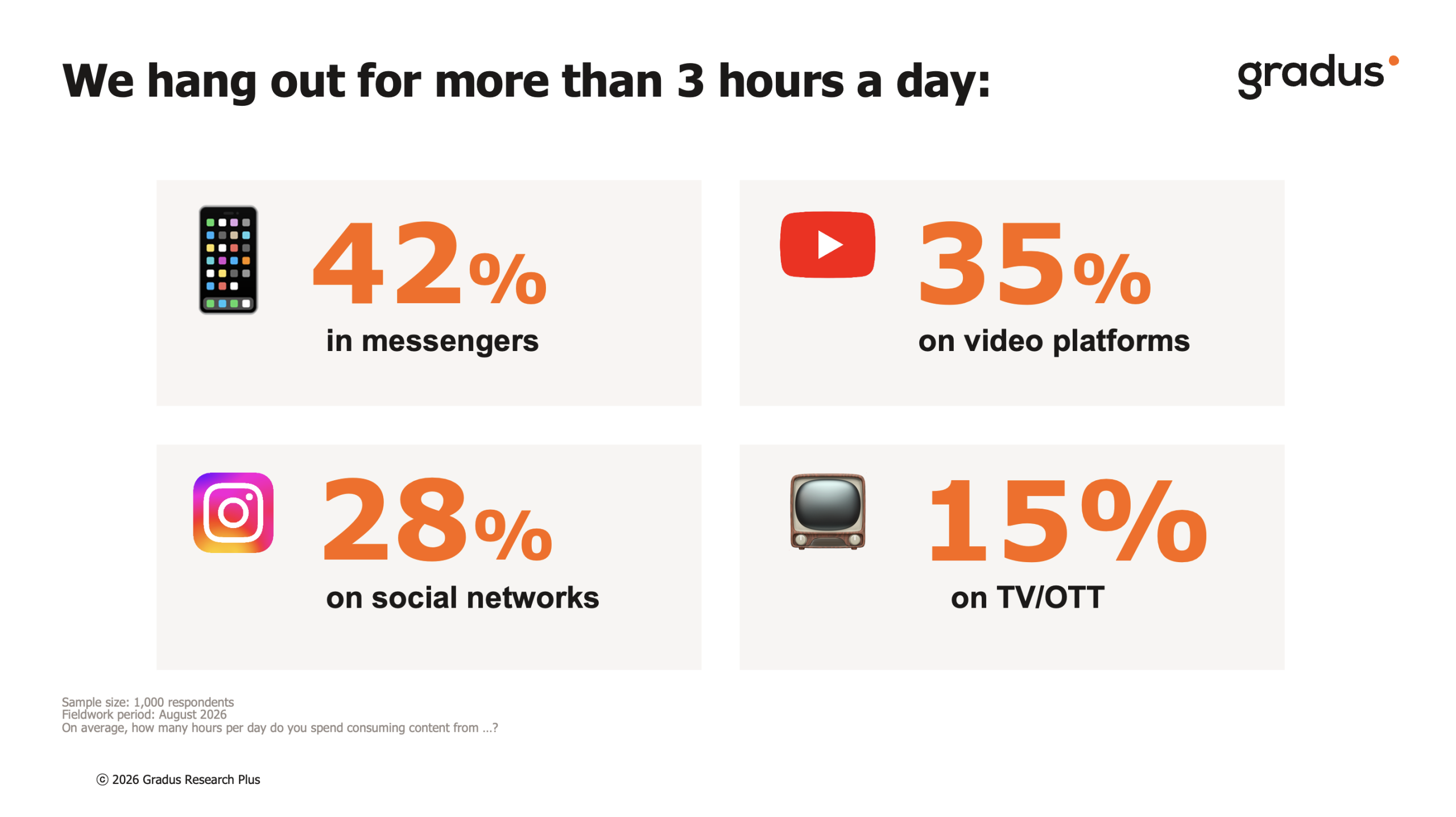
Social media therefore records the highest average consumption time, while messaging apps lead in the share of users who spend more than three hours a day on them.
Where Ukrainians follow the news and where they go for entertainment
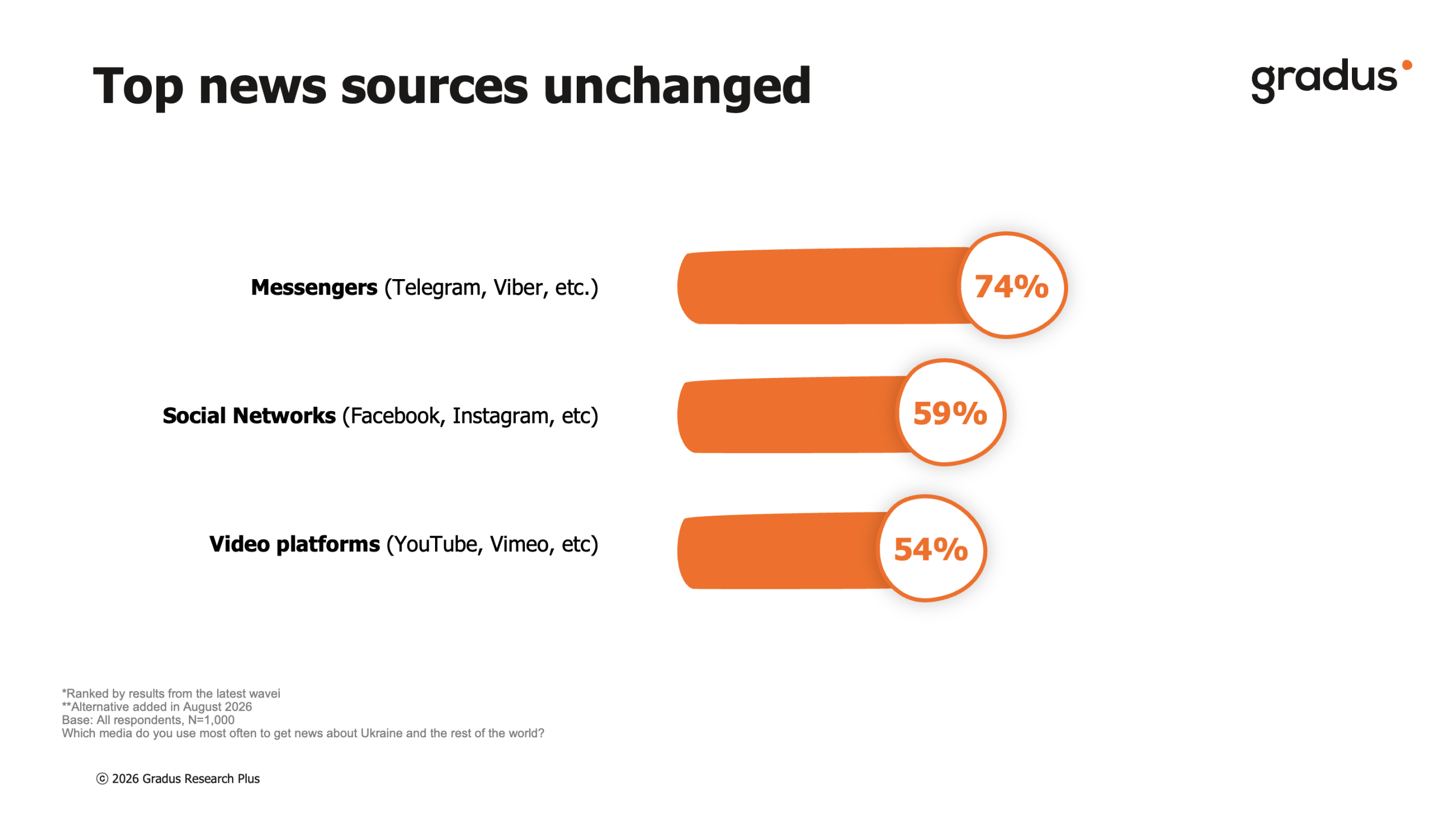
Ukrainians are increasingly using different platforms for different purposes. Messaging apps remain the main channel for following news from Ukraine and around the world, used for this purpose by 74% of respondents. Social media ranks second at 59%, followed by video platforms at 54%.
The pattern is different when it comes to entertainment. Some 61% of respondents use video platforms to relax and switch off, while more than half turn to social media and messaging apps.
The same digital ecosystem therefore serves a range of functions: messaging apps help people stay informed and maintain social connections, while video platforms and social media increasingly provide space for entertainment and relaxation.
Smartphones and Smart TVs: two screens for different viewing scenarios
The smartphone remains the main device for accessing online content: 89% of respondents used one for this purpose during the previous week. Smartphones are widely used across all age groups and media consumption profiles covered by the study.
At the same time, the big screen remains highly relevant. Among respondents who own a television, 66% use a Smart TV. This is noticeably higher than in 2024, when the figure stood at 55%, and broadly in line with the 2025 level.
The dominant role of smartphones has therefore not displaced the big screen. Different devices continue to coexist, serving different user needs and consumption scenarios.
Interest in news is declining, while films and music remain stable
Changes are taking place in the types of content Ukrainians choose as well. Films and TV series remain the most popular format, selected by 79% of respondents. Music and music programmes are of interest to 68%.
Data from the past three years show that interest in these formats has remained relatively stable, fluctuating by only a few percentage points from year to year.
At the same time, interest in certain information-based formats is changing. Documentaries, documentary series and programmes returned to 54% after declining in 2025. Meanwhile, 49% of respondents choose news and socio-political programmes, compared with 54% in 2024.
News therefore remains an important part of Ukrainians’ media consumption, while entertainment content continues to play a significant role in helping audiences relax, unwind and switch away from everyday realities.
The three most popular messaging apps remain unchanged in 2026: Telegram is used by 74% of respondents, Viber by 59%, and Facebook Messenger by 54%.
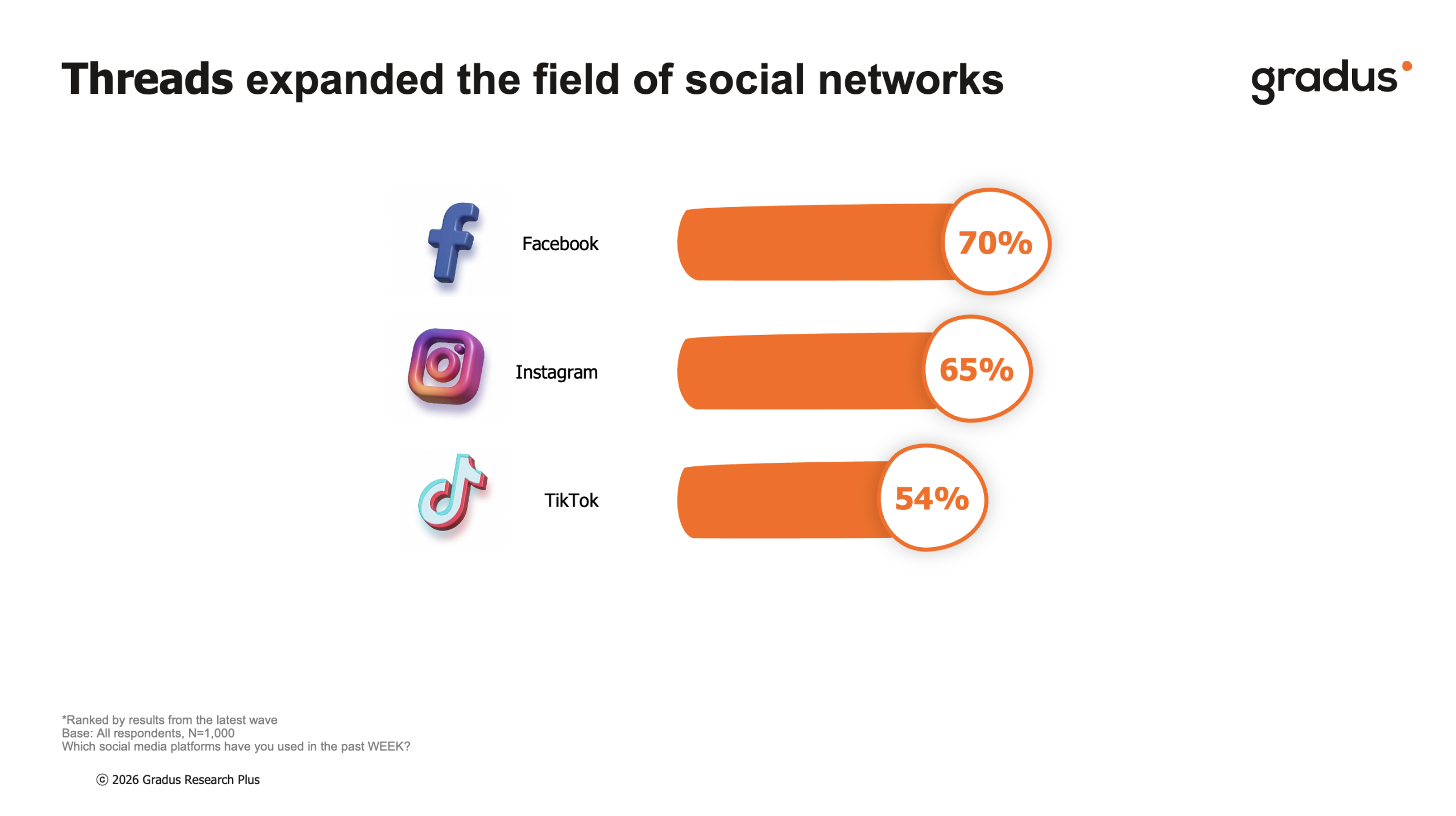
For regular social media use, Facebook leads at 70%, followed by Instagram at 65% and TikTok at 54%. Threads is also steadily gaining ground: 21% of respondents used the platform during the previous week.
“Media consumption among Ukrainians is becoming increasingly purpose-driven: people choose a platform, device and format depending on what they need at a particular moment — whether that is quickly catching up on the news, communicating, watching video, or switching to entertainment content. As a result, attention is spread across different channels and screens throughout the day, making media behaviour increasingly fragmented. For media companies and brands, being present on a popular platform is no longer enough. What matters is understanding why people come to that platform and the context in which they engage with content,” comments Evgeniya Blyznyuk, sociologist, founder and CEO of Gradus.
The survey was conducted by Gradus Research using a self-administered questionnaire in the Gradus mobile application. The sample reflects the population structure of cities with more than 50,000 residents among people aged 18–60, excluding temporarily occupied territories and areas of active hostilities. Fieldwork was conducted on 12–13 August 2025. Sample size: 1,000 respondents.