What products are consumers switching to and what does a typical Ukrainian diet look like? Which categories are saved on and which are cut last? Do they stock up and how do they prepare for the cold season? How do survival strategies differ depending on age and place of residence? These and other questions about changing eating habits were examined by analysts from Gradus Research in a special survey for the New Food Summit 2024.
Almost half of the Ukrainians surveyed (49%) say that their eating habits have changed since the beginning of the full-scale invasion. Among young people aged 18-34, this figure is even higher – 54%.
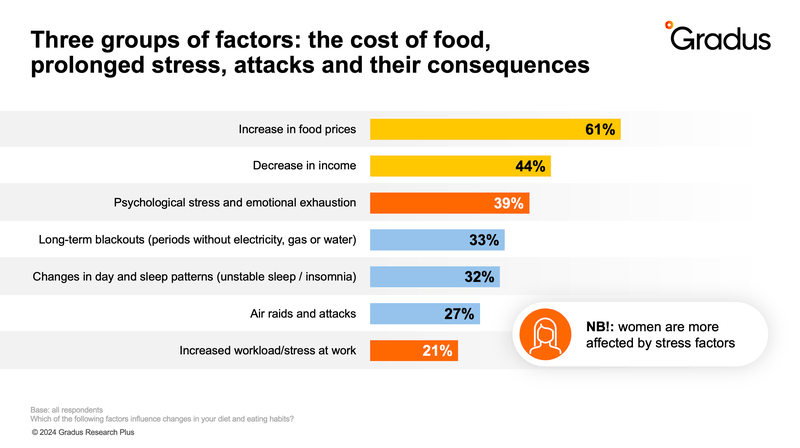
Among the key factors influencing the change in eating habits, respondents named higher food prices, prolonged stress, and enemy attacks with their consequences.
However, when assessed in detail, stress (83%) ranks first among the factors influencing changes in eating habits. Due to stress and emotional exhaustion, half of the Ukrainians surveyed eat irregularly (49%), eat more unhealthy food (42%), have a reduced appetite (41%), and skip some meals (41%). 19% of respondents also indicated that they have started drinking more alcohol.
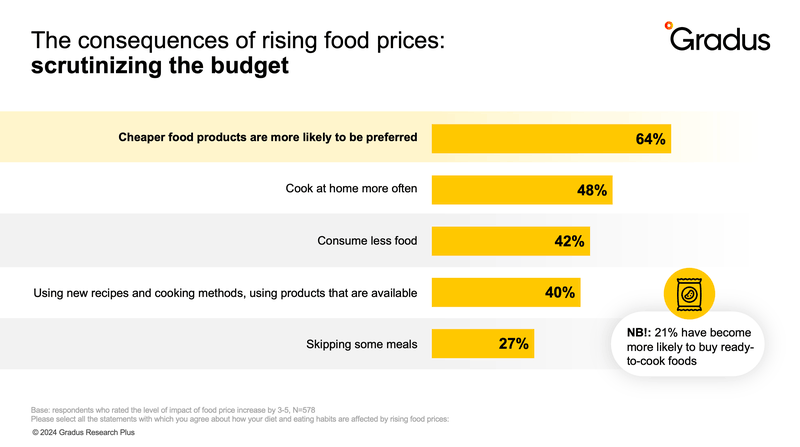
Due to the rise in food prices during the war, almost two-thirds (64%) of respondents choose cheaper products, and almost half of respondents cook at home more often (48%).
Blackouts also have a significant impact on the eating habits of Ukrainians. As a result of power, heating, or water outages, respondents most often mentioned that they prefer long-term storage products (59%) and cold food (50%).
“Living in the war and the experience of blackouts have made Ukrainian consumers hardened. People are rebuilding their diets and adapting their habits. At the same time, a third of respondents have alternative sources of power, and another third have alternative means of heating and cooking. And only 34% of respondents consider leaving the settlement or the country in case of prolonged blackouts,” comments Evgeniya Blyznyuk, sociologist, CEO&Founder of Gradus Research.
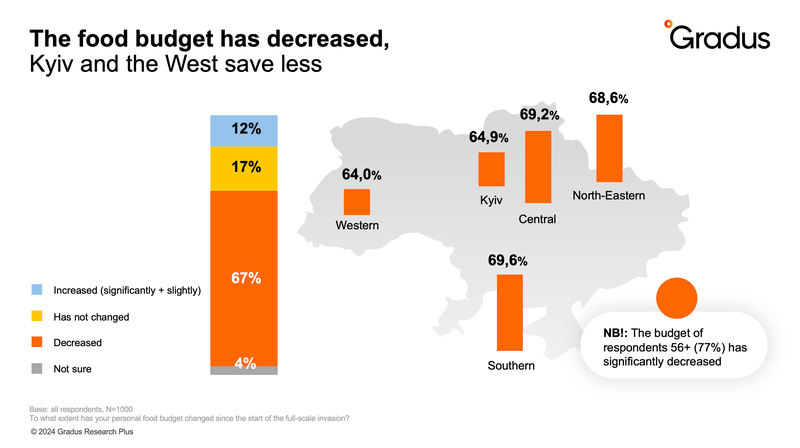
The war has forced Ukrainians to cut their food budget. These changes are most pronounced among respondents in the 56+ age group, with 77% of them saving money.
Confectionery (49%) and fish and seafood (48%) are among the categories on which people save the most. While the category of basic products has hardly been affected by budget cuts – only 11% of respondents save on bread, oil, flour, cereals, vegetables and eggs.
The survey was conducted by Gradus Research using a self-administered questionnaire in the Gradus mobile application. The sample reflects the population structure of cities with more than 50 thousand inhabitants aged 18-65 by gender, age, settlement size, and region, excluding temporarily occupied territories and territories of active hostilities. The period of the field: October 8, 2024. Sample size: 1000 respondents.
The menu of war: how full-scale invasion changes the eating habits of Ukrainians – survey data
What products are consumers switching to and what does a typical Ukrainian diet look like? Which categories are saved on and which are cut last? Do they stock up and how do they prepare for the cold season? How do survival strategies differ depending on age and place of residence? These and other questions about changing eating habits were examined by analysts from Gradus Research in a special survey for the New Food Summit 2024.
Almost half of the Ukrainians surveyed (49%) say that their eating habits have changed since the beginning of the full-scale invasion. Among young people aged 18-34, this figure is even higher – 54%.
Among the key factors influencing the change in eating habits, respondents named higher food prices, prolonged stress, and enemy attacks with their consequences.
However, when assessed in detail , stress (83%) ranks first among the factors influencing changes in eating habits. Due to stress and emotional exhaustion, half of the Ukrainians surveyed eat irregularly (49%), eat more unhealthy food (42%), have a reduced appetite (41%), and skip some meals (41%). 19% of respondents also indicated that they have started drinking more alcohol.
Due to the rise in food prices during the war, almost two-thirds (64%) of respondents choose cheaper products, and almost half of respondents cook at home more often (48%).
Blackouts also have a significant impact on the eating habits of Ukrainians. As a result of power, heating, or water outages, respondents most often mentioned that they prefer long-term storage products (59%) and cold food (50%).
“Living in the war and the experience of blackouts have made Ukrainian consumers hardened. People are rebuilding their diet and adapting their habits. At the same time, a third of respondents have alternative sources of power, and another third have alternative means of heating and cooking. And only 34% of respondents consider leaving the settlement or the country in case of prolonged blackouts,” comments Yevheniia Blyzniuk, sociologist, founder and director of Gradus Research.
The war has forced Ukrainians to cut their food budget. These changes are most pronounced among respondents in the 56+ age group, with 77% of them saving money.
Confectionery (49%) and fish and seafood (48%) are among the categories on which people save the most. While the category of basic products has hardly been affected by budget cuts – only 11% of respondents save on bread, oil, flour, cereals, vegetables and eggs.
The survey was conducted by Gradus Research using a self-administered questionnaire in the Gradus mobile application. The sample reflects the population structure of cities with more than 50 thousand inhabitants aged 18-65 by gender, age, settlement size, and region, excluding temporarily occupied territories and territories of active hostilities. The period of the field: October 8, 2024. Sample size: 1000 respondents.
The full research report is available on a commercial basis.
Structure of the full report:
Changes in eating habits after 02/24/2024 by age and region
Factors influencing changes in diet and eating habits by gender and age
Estimates of the impact of factors on changes in diet and eating habits by gender and age
Changes in diet and eating habits due to psychological stress and emotional exhaustion, increased food prices, changes in daily routine and sleep, blackouts, air raids and attacks
Changes in personal food budget after 02/24/2022 by gender, age and region
Food products on which people save by gender and age
Food products that respondents stock up on by gender
Availability of alternative sources of electricity by gender and age
Availability of alternative means of heating and cooking by gender and age
Possibility to leave the settlement or country disaggregated by age and presence of children
Conditions for possible departure from the settlement or country in terms of age and presence of children
Experience of divorce / ending a relationship during a full-scale invasion
Cost: $500
To purchase the report, please contact dn@gradus.app