AFU, volunteering, and IT: Gradus research identified three pillars of national pride for Ukrainians in 2025
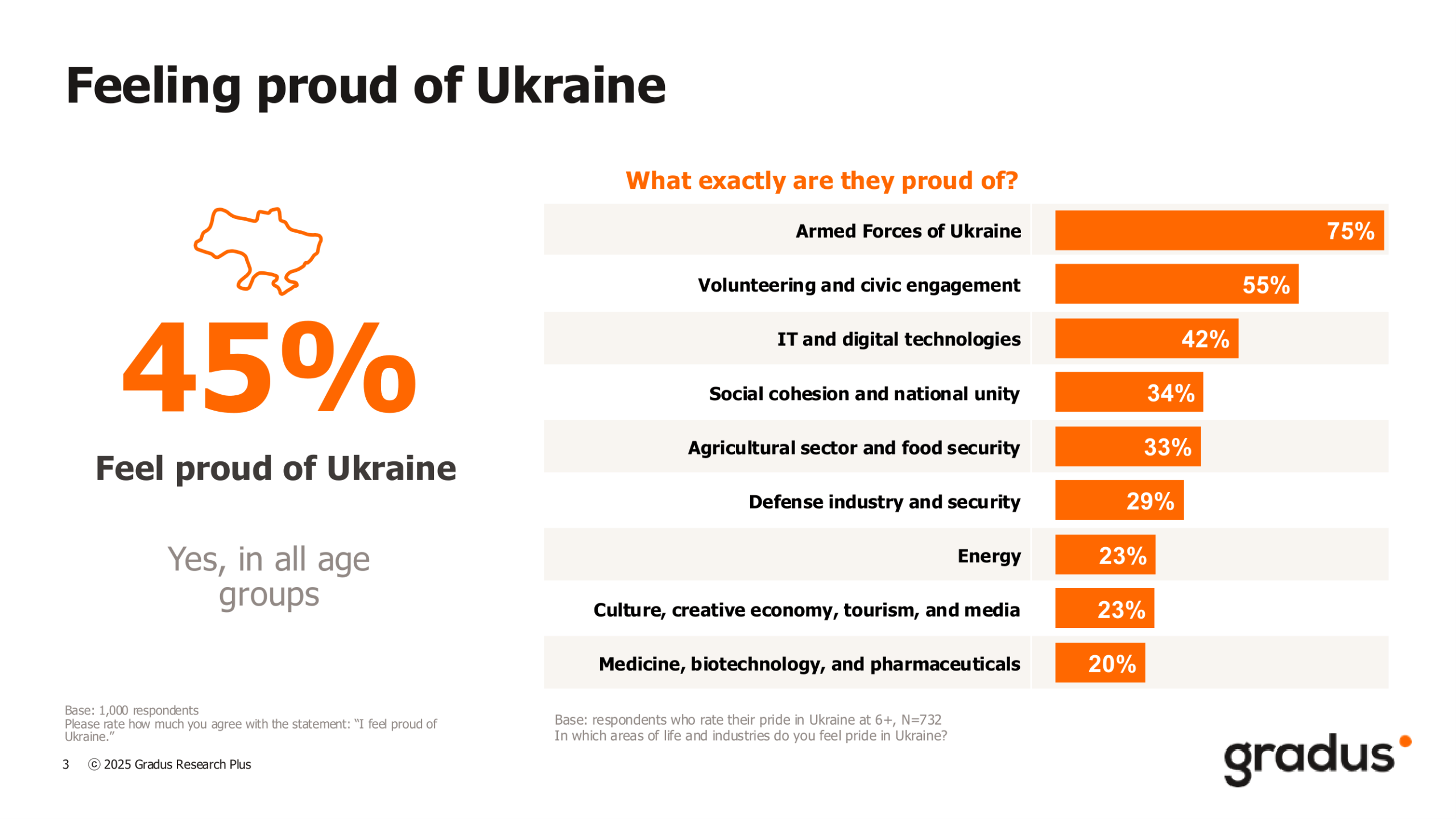
Under the influence of the war for the country’s existence and independence, Ukrainians have begun to better realize national achievements and priorities. According to the results of the Gradus study “Ukraine 2035: Strength, Vulnerability, and Potential of the Country,” conducted in November 2025, the absolute majority of Ukrainians of all age groups (75%) are proud of our Armed Forces. Second place is occupied by volunteer and civic activity (55%), and third — digital technologies (42%). At the same time, the share of those who do not see any achievements of the state has decreased almost threefold compared to the pre-war year 2021.
Contribution to development and Independence
Survey respondents noted that it was these three areas (AFU — 80%, volunteers — 76%, and IT — 71%) that were the drivers of the country’s development throughout the years of Independence. The agricultural sector — 62%, social cohesion — 57%, and the defense industry — 54% also received high marks. In contrast, respondents see the least significant contribution in the law enforcement and judicial systems (63% distrust), public administration, and institutional capacity.
Feelings of pride for Ukraine
A similar situation exists regarding the question of the potential for development and strengthening the country’s resilience by 2035. The first place is also occupied by the AFU with a result of 80%, the second by IT and digital technologies (75%), and the third with a result of 69% is shared between the agricultural sector and food security, volunteering and civic activity, and the defense industry.
Changing perception of achievements
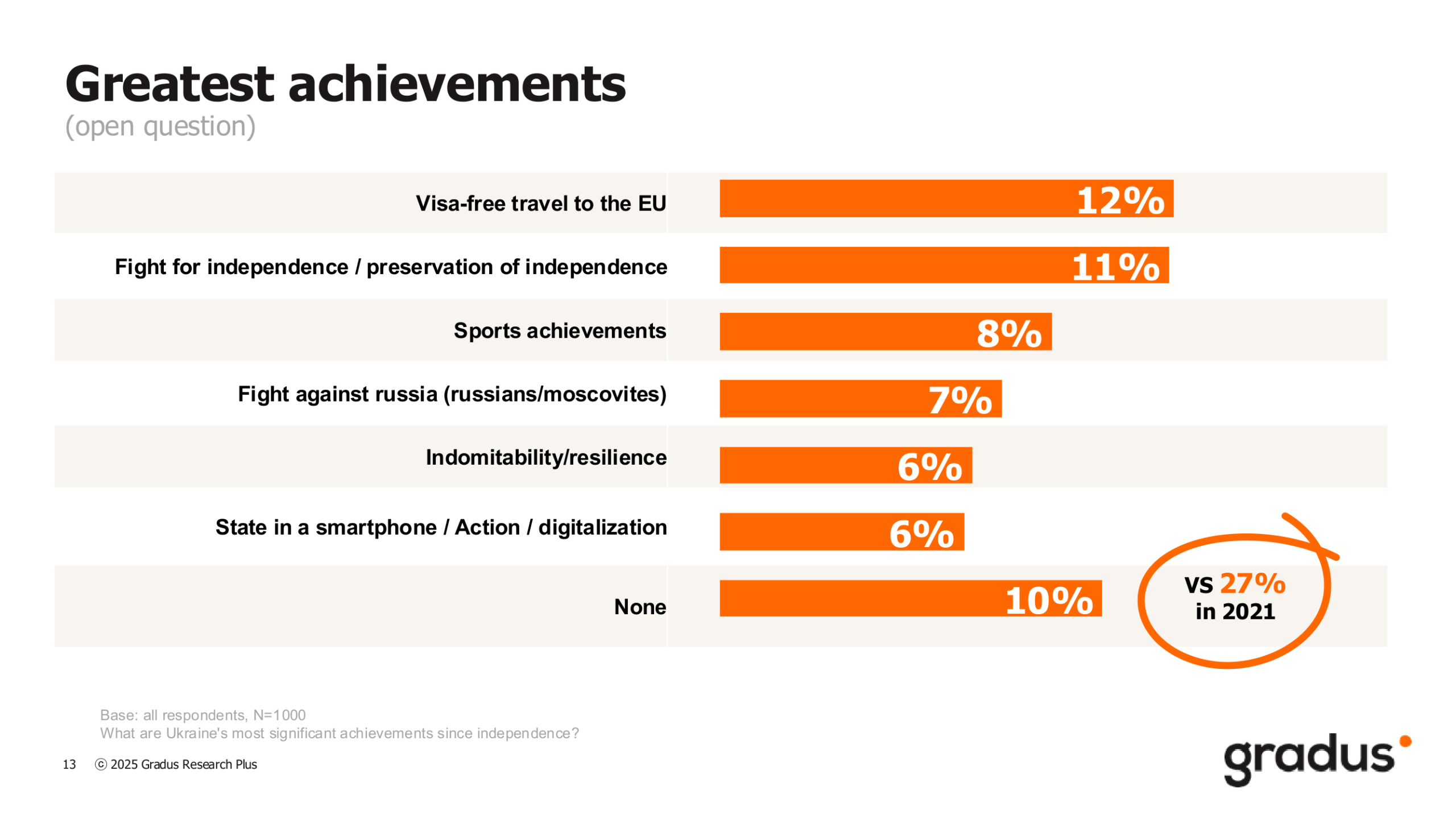
The survey highlighted that the war crystallized national identity and forced a reassessment of real achievements. In the 2021 survey, 27% of respondents could not identify any significant achievement of Ukraine. In 2025, this figure decreased to 10%, which indicates an increase in the value of the state in the eyes of citizens. Among specific historical achievements, the visa-free regime with the EU (12%) and the preservation of independence (11%) are the leaders.
Greatest achievements
Vector of the future: Ukraine 2035
Responding to questions about development potential for the next 10 years, Ukrainians are betting on MilitaryTech, IT, and the agricultural sector. Citizens see Ukraine’s role on the world stage as a “shield of Europe” — an area for active investment, which, however, has partially limited subjectivity.
Vision of Ukraine’s role 2035
In answers to the open-ended question, Ukrainians named the defense industry, IT and digitalization, the agricultural sector and food security, the army, construction, and energy as the areas with the greatest development potential.
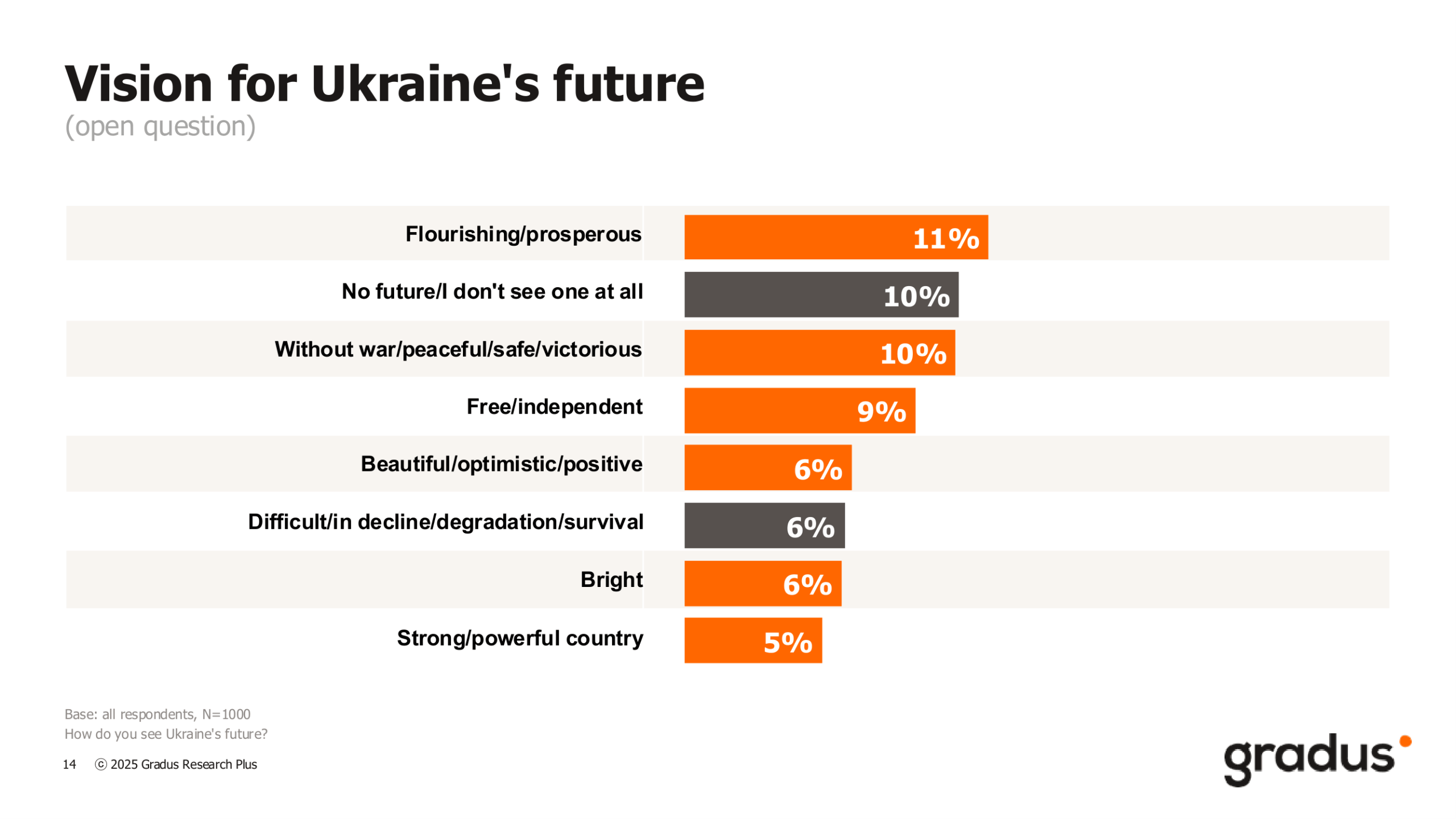
In general, the majority of respondents see Ukraine’s future in a positive light. Positive answers to the open-ended question about the future (peaceful, flourishing, free, optimistic, bright) were given by a total of 47%. In a negative light (difficult, in decline, no future) — only 16%.
Conflict of paternalism and responsibility
Comparing the answers provided by Ukrainians in the pre-war 2021, in the first year of the war, and at the end of 2025, the share of those who rely on the state for their well-being has increased. At the same time, regarding the role of state intervention in the personal affairs of citizens and the balance of personal and public interests, Ukrainians are mostly inclined toward individualism and freedom.
The results of the study highlighted an interesting conflict in the worldview of Ukrainians in 2025. On the one hand, the demand for paternalism is growing — we expect security and well-being from the state. On the other hand, Ukrainians remain convinced individualists for whom freedom and non-interference in personal life are absolute values. The balance between these two vectors will determine the social contract in the next 10 years,
– comments Evheniya Blyznyuk, sociologist, CEO and founder of the research company Gradus.
The full research report is available for download via the form below.
The study was conducted by the research company Gradus using the method of self-completion of the questionnaire in the Gradus mobile application. The sample reflects the structure of the population of cities with more than 50,000 inhabitants aged 18-60 by gender, age, size of the settlement, and region, with the exception of temporarily occupied territories and territories of active hostilities. Fieldwork period: November 7-10, 2025. Sample size: 1000 respondents.