Stress and Burnout as the New Normal: What Ukrainian Employees Truly Value in Employers and Why They Resign
Gradus Research conducted a special HR survey titled “Employee Expectations Amid Widespread Burnout” and presented its findings at the 17’ People Management Conference. The survey explored the emotional state of Ukrainian workers and what they expect from employers in conditions of prolonged stress and emotional exhaustion.
The results show that the most important factors for employees remain financial compensation and work-life balance—cited by 46% of respondents. The top five also include team atmosphere (33%), flexible work models (27%), and career growth opportunities (23%).
Workload and Uncertainty Are Key Sources of Stress
According to 42% of respondents, excessive workload is the main source of stress at work. Over a third (35%) also pointed to company uncertainty as a major stressor.
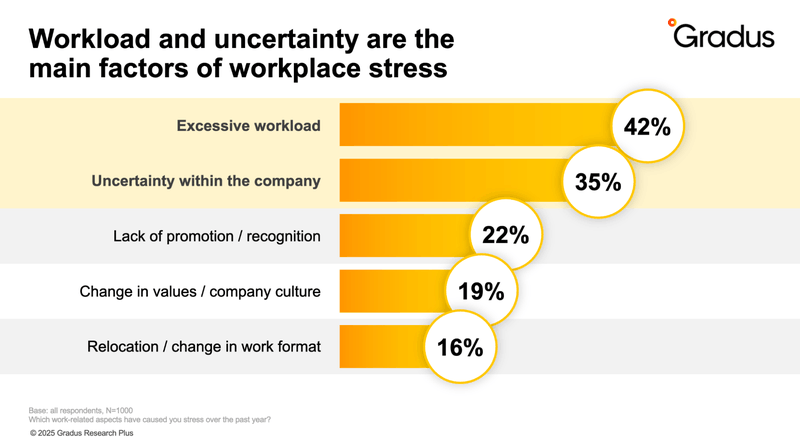
eNPS is Negative Across All Demographics and Declines with Age
It is questionable whether employees are receiving the benefits they expect from their jobs. The Employee Net Promoter Score (eNPS) stands at -19, indicating low employee loyalty—more employees are dissatisfied or unwilling to recommend their company than those who would.
The least dissatisfied are young people aged 25–35 (-8) and 18–24 (-10), while the most dissatisfied are employees aged 45–54 (-26) and 55–65 (-34). The score also varies by work format, as illustrated in the accompanying infographic.
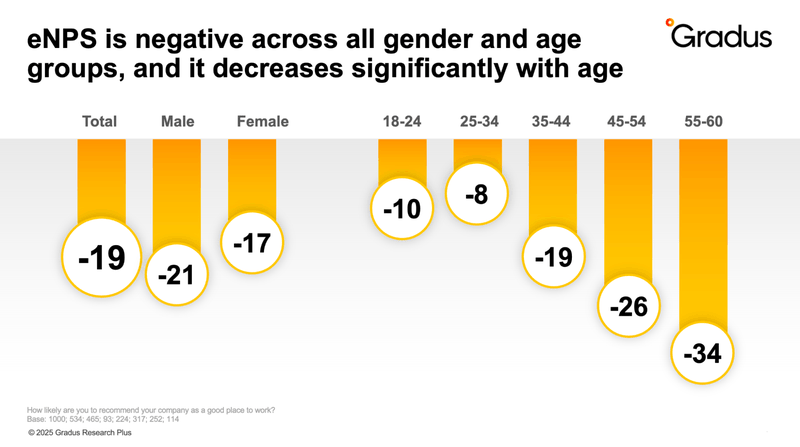
How Do People React to Stress?
The full-scale invasion, economic instability, and daily challenges generate stress that affects people’s work lives. Many engage in compulsive news consumption and social media scrolling. Some feel drained already in the morning and emotionally empty by the end of the workday.
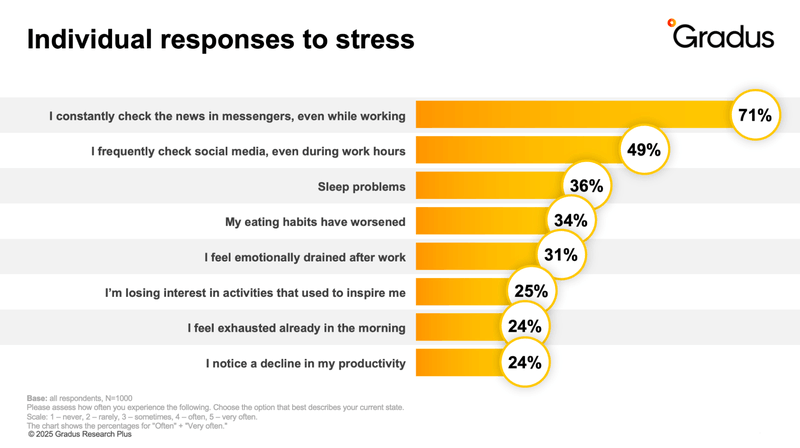
“We are all living under conditions of prolonged, extreme stress. Our research shows that compared to previous years, more respondents are recognizing symptoms of burnout. This impacts both productivity and team stability. That’s why we looked into the different types of burnout among Ukrainian employees—because knowing the type can help employers apply the right tools to support their teams. We obtained very insightful and practical results,” — says Evgeniya Blyzniuk, sociologist, founder, and CEO of Gradus Research.
Financial Incentives Top the List of Expectations
Employees expect adequate compensation from their employers. This is also perceived as a tool for psychological support.
Everyone Burns Out — But Differently
Stress and burnout affect people differently, impacting their motivation, willingness to stay, and likelihood of recommending their company. Based on the results, employees were grouped into five clusters: Chronically Overloaded, Exhausted and Demotivated, Balancing Between Inspiration and Burnout, Stable but Indifferent, Engaged and Inspired.
All groups are considering resignation due to stress or burnout. The least likely to quit are the engaged and inspired (18%), while the most likely are the chronically overloaded (75%).
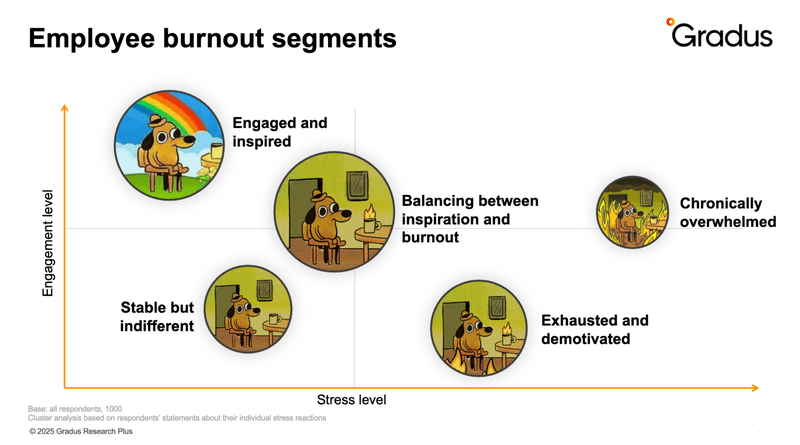
This also affects how likely they are to recommend their workplace. The exhausted and demotivated group has the lowest eNPS (-68), while the engaged and motivated show a positive eNPS (31).
The survey was conducted by Gradus Research via a self-completed questionnaire in the Gradus mobile app. The sample reflects the structure of the Ukrainian population aged 18+ by gender and age in cities with populations over 50,000 (excluding temporarily occupied territories and areas of active combat). Fieldwork date: May 8, 2025. Sample size: 1,000 respondents.
The full research report is available on a commercial basis upon request at dn@gradus.app.
The report includes: