The government reshuffle has sparked mixed reactions among the public. While opinions among those surveyed were almost evenly split regarding the replacement of the prime minister, the majority of respondents do not support the decision to dismiss Mykhailo Fedorov. This is according to the results of a poll conducted by Gradus on July 16–17, 2026.
No clear consensus on the replacement of the prime minister
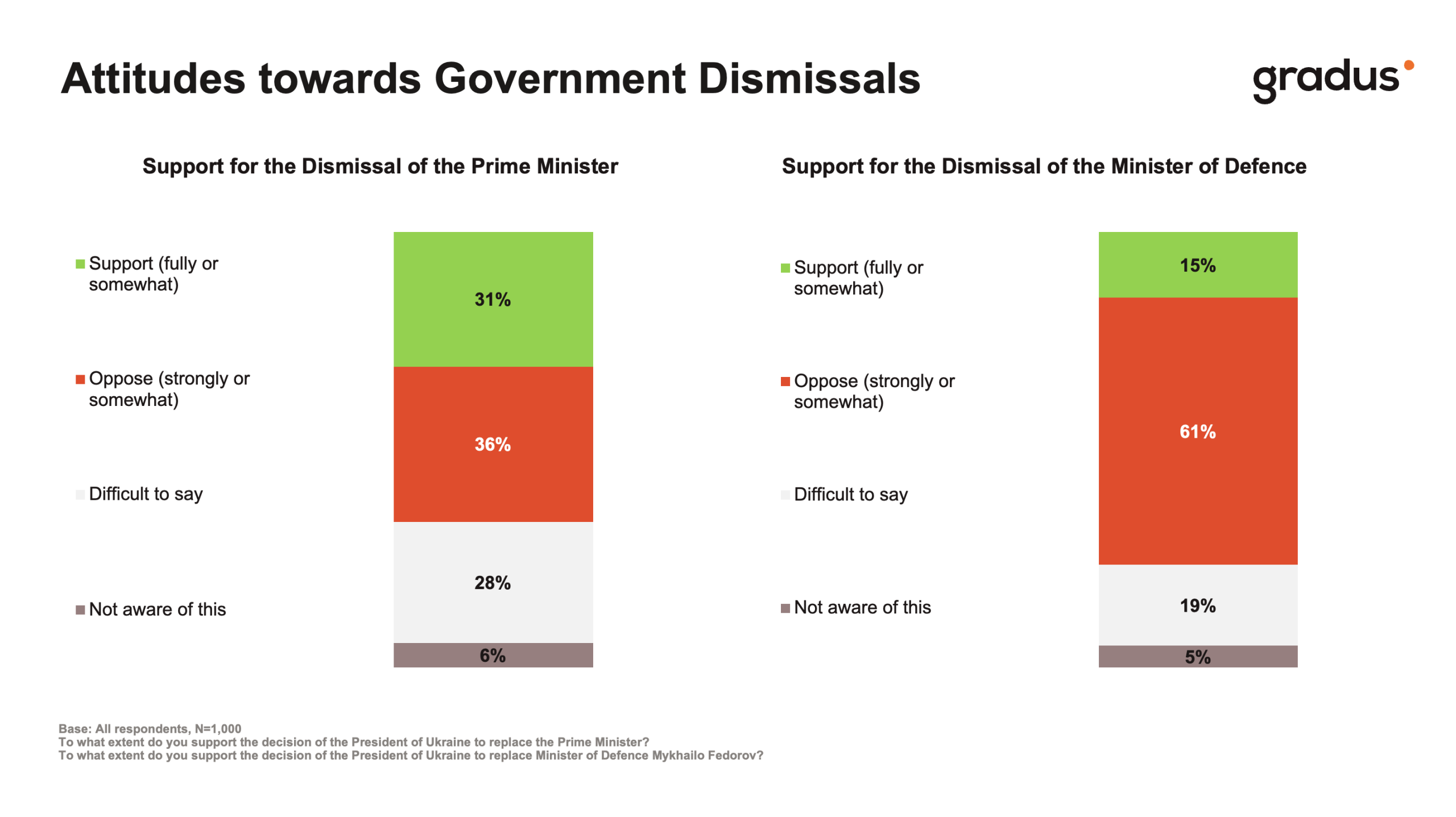
The dismissal of Prime Minister Yuliia Svyrydenko is fully or somewhat supported by 31% of respondents. Meanwhile, 36% somewhat or strongly oppose the decision. A further 28% were unable to express a clear opinion, while 6% said they were unaware of the government changes.
Six in ten oppose the dismissal of Defence Minister Mykhailo Fedorov
The decision to replace Mykhailo Fedorov as Minister of Defence has received a much clearer public response.
Overall, 61% of respondents somewhat or strongly oppose his dismissal. This includes 51% who said they strongly disapprove of the decision.
Only 15% support replacing the defence minister, while 19% were unable to express a clear opinion and 5% were unaware of the decision.
At the same time, 49% of surveyed Ukrainians believe that Fedorov’s dismissal and the appointment of a new minister will weaken Ukraine’s defence capabilities.
Conflict with the military leadership seen as the main reason for the dismissal
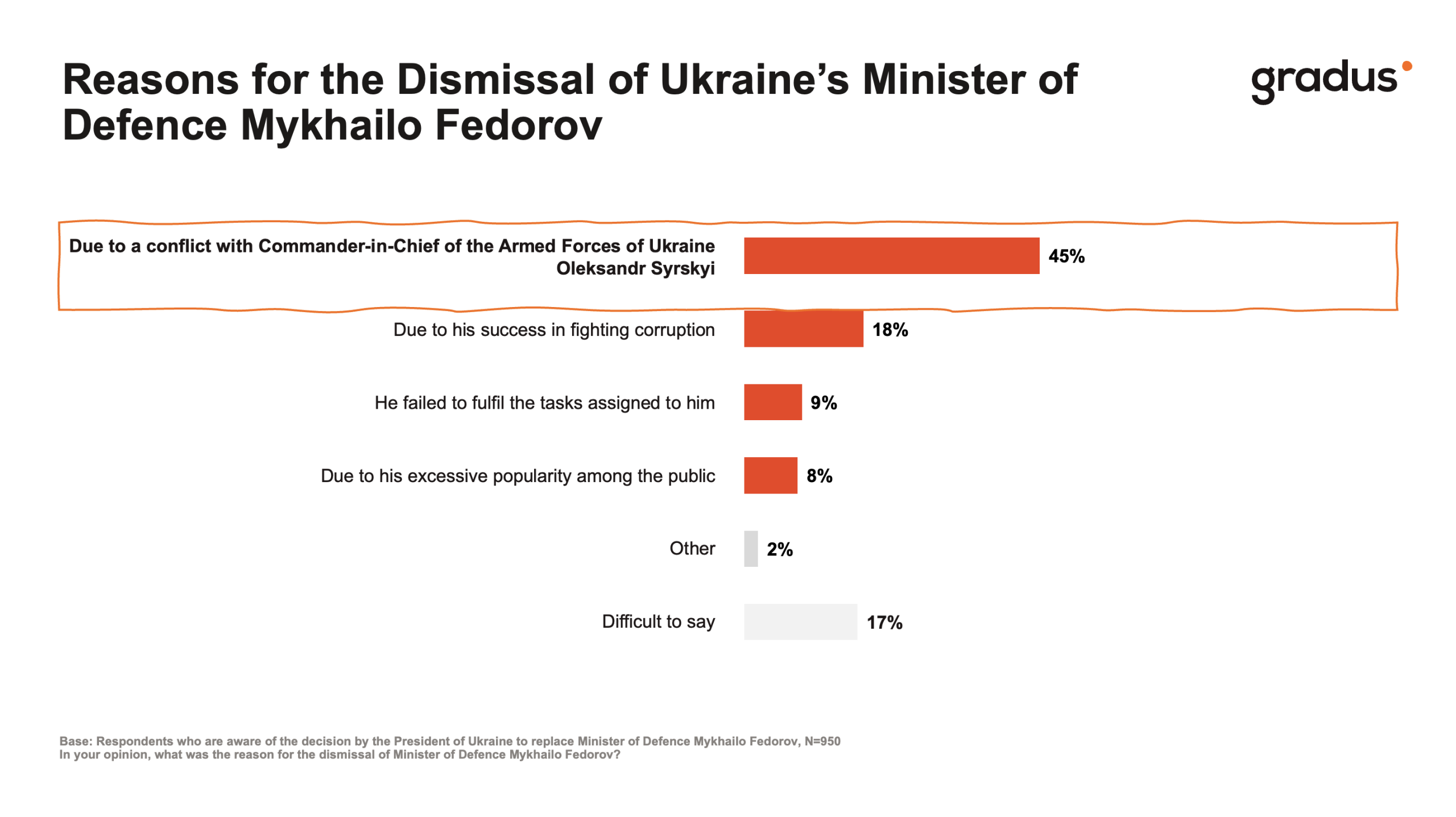
Among respondents who are aware of the decision to replace the defence minister, 45% identified a conflict between Mykhailo Fedorov and Commander-in-Chief of the Armed Forces of Ukraine Oleksandr Syrskyi as the main reason for his dismissal.
A further 18% associate the decision with Fedorov’s success in combating corruption, while 9% believe he failed to fulfil the tasks assigned to him. Another 8% attribute his dismissal to his high level of popularity among the public.
The survey was conducted by the research company Gradus using a self-completion questionnaire in the Gradus mobile application. Fieldwork was conducted on 16–17 July 2026. The sample comprised 1,000 respondents. The sample reflects the population structure of Ukrainian cities with more than 50,000 residents among people aged 18–60, excluding temporarily occupied territories and areas of active hostilities.