At the New Food Summit 2025, we presented the results of the third wave of a special study on how the full-scale war affects the eating behavior of Ukrainians.
The data shows that the war continues to significantly change our daily decisions — from what we put in our shopping cart to how we define a “healthy life” for ourselves.
Impact of the war: more than half of Ukrainians changed their eating habits
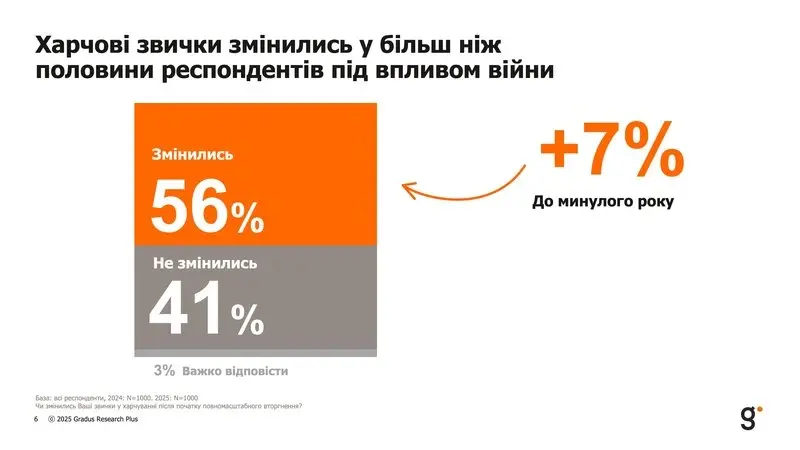
56% of respondents note that their diet has changed under the influence of the war, which is 7 percentage points more than last year.
Eating habits changed in more than half of the respondents under the influence of the war
The main factors of these changes are rising prices, psychological stress and the consequences of attacks that affect everyday life and the rhythm of life.
Three groups of influence factors: cost, stress, attacks and their consequences
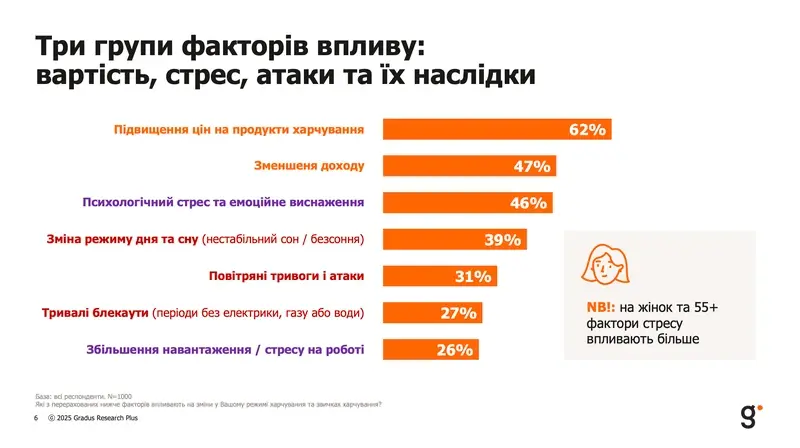
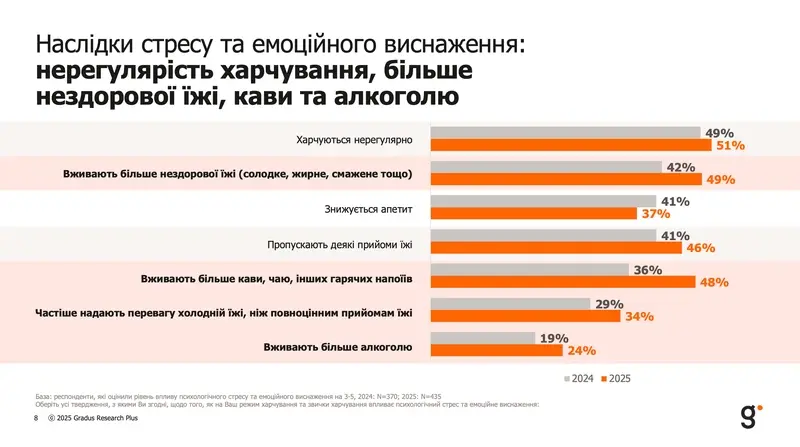
For women and people 55+, the impact of emotional exhaustion and sleep disturbance is especially significant — these factors have a stronger influence on the regularity of eating and product choices.
Consequences of stress and emotional exhaustion
The food budget continues to shrink
Despite adapting to the new reality, Ukrainians are still forced to save money.
The share of those who reduced spending on food increased from 67% to 72%. Residents of Kyiv and the Western region, where income levels are traditionally higher, cut food budgets the least. The East and South demonstrate the greatest savings.
What do they save on?
Most respondents try to limit confectionery, snacks and delicacies.
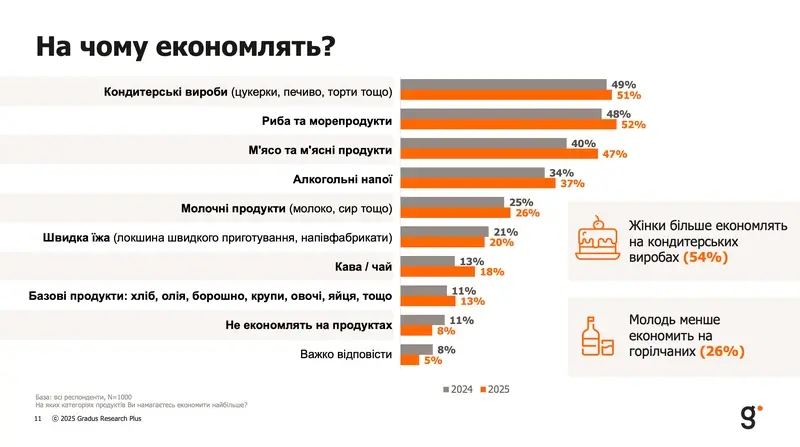
Women are more likely to give up sweets (54%), while young people are less likely to save on alcoholic beverages (26%).
Thus, Ukrainians consciously simplify consumption, focusing on basic products and minimizing “emotional” purchases.
The full-scale war has made nutrition for Ukrainians not just a physiological need, but a part of the survival mechanism. Through food, we try to organize life, find stability and at least some normalcy in everyday stress,
— comments Evheniya Blyznyuk, sociologist, founder and director of Gradus Research.
The study was conducted by the research company Gradus by the method of self-completion of the questionnaire in the Gradus mobile application. The sample reflects the structure of the population of cities with more than 50,000 inhabitants aged 18-60 by gender, age, size of the settlement and region, with the exception of temporarily occupied territories and territories of active hostilities. Fieldwork period: wave 1 — October 8, 2024, wave 2 — October 9, 2025. Sample size: 1000 respondents.